
Ah, the joys of employerhood. Having a team of employees to help grow your business can be a beautiful thing. But, getting the hang of payroll (especially payroll taxes) takes time. Not to mention, a multi-state payroll situation can confuse newbie and established employers alike. What’s an employer to do?
Handling multi-state payroll processing starts with understanding multi-state payroll compliance. So, are you ready to get started?
Quick answer: How to run multi-state payroll
- Register for payroll accounts in each state where employees perform work (withholding, SUTA, and any local accounts).
- Track where work is performed (not just where employees live). Taxes usually follow the work location.
- Withhold state/local income taxes per work state rules; apply reciprocity if it exists between work and home states.
- Determine SUTA in only one state using the Department of Labor’s “Localization of Work” tests.
- File and pay all required federal, state, and local returns on schedule; keep records by state.
- Review other requirements (paid leave, disability insurance, local taxes) and run periodic compliance checks.
What is multi-state payroll?
Payroll is the process of calculating an employee’s pay, withholding taxes and other deductions, and paying the employee. Multi-state payroll is this same process of calculating, withholding, and paying, but in multiple states.
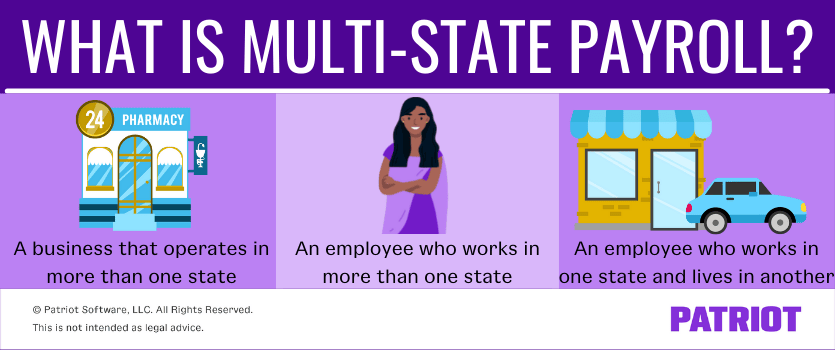
Multi-state payroll can refer to the following situations:
- A business that operates in more than one state
- An employee who works in more than one state
- An employee who works in one state and lives in another
Regardless of which type of situation your business has, the gist of multi-state payroll processing is the same: taxes can get wonky.
In all cases, track the state where services are performed. That location generally drives withholding, reporting, and many wage-and-hour rules.
Note: Nine states do not tax wage income (Alaska, Florida, Nevada, New Hampshire, South Dakota, Tennessee, Texas, Washington, Wyoming). You will still owe applicable SUTA or other state/local taxes.
Your multi-state payroll tax guide
Multi-state payroll tax withholding can get pretty confusing, pretty fast. In fact, payroll tax withholding for one state can be overwhelming enough.
First, let’s review the taxes you need to withhold, contribute, or withhold and contribute when running payroll:
| Federal Taxes | State Taxes |
|---|---|
| Federal income tax | State income tax |
| FICA tax (Social Security and Medicare taxes) | State unemployment tax (SUTA or SUI tax) |
| Federal unemployment tax (FUTA tax) | Other state-specific taxes |
Multi-state payroll doesn’t impact federal taxes. So, withhold federal income tax from employees’ wages like normal. Withhold and contribute FICA tax like normal. And, pay federal unemployment tax on the employees’ wages like normal.
It’s the state taxes that can get tricky.
Avoid potential payroll issues for multi-state employers by understanding the additional payroll considerations you need to make:
- State income tax withholding
- State unemployment tax
- Other state-specific taxes
State income tax withholding
State income tax is an employee-only tax, so you must withhold it from your employees’ wages and remit it to the state. The amount you withhold depends on the state and the employee’s state W-4 information, if applicable.
Which state income tax rate applies? Generally speaking, withhold state taxes for the state where the employee performs work.
Say you have an employee who works in another state from your business location. You likely need to withhold income tax for that state because of your business presence (aka “nexus”).
Let’s say an employee lives in one state and works in another. Typically, you just need to withhold state income tax for the state they perform work, and the employee pays tax for their state with their tax return. However, check to see if there’s a reciprocal agreement between the states. If there is, withhold only for the state the employee lives in. If there’s no reciprocal agreement, you may decide to withhold for both the state they perform work and the state they reside (i.e., a courtesy withholding).
Say you have an employee who works in multiple states throughout the year. Because you withhold and remit state taxes for the state where the employee works, you may need to handle state income tax for multiple states, depending on how long the employee works in each state. Check each state’s rules for specifics.
Quick decision rules:
- If the work state and home state have a reciprocity agreement, withhold for the home state (employee may need to submit a nonresidency certificate to the work state).
- If no reciprocity applies, withhold for the work state. The employee generally claims a credit on their resident return to avoid double taxation.
- Some states and localities require withholding after a de minimis threshold (e.g., certain days worked or dollar amounts). Check the work state’s rules, especially for short-term or traveling employees.
- Local income taxes may apply in certain states and cities (for example, parts of Ohio and Pennsylvania). Register and withhold where required.
- Pro tip: Use time and location tracking so you can apportion wages accurately when employees work in multiple states.
State unemployment tax
In most states, state unemployment tax is an employer-only tax. That means you do not withhold it from employees’ wages (exception: Alaska, New Jersey, and Pennsylvania).
So the question is: If you have a multi-state payroll situation, where do you send your SUTA tax deposits?
Do not pay SUTA tax to more than one state for a multi-state employee. Instead, follow unemployment tax rules for multi-state employees so you know which SUTA tax fund to pay into.
Use the Department of Labor’s Localization of Work Provisions tests to determine which state an employee is covered by for unemployment (in the following sequence):
- Localization of service: Is the employee’s service localized in one state? If so, this is the state for SUTA tax.
- Base of operations: If the employee’s work is not localized in a state, do they perform some service in the state where their base of operations is located?
- Direction and control: If the employee does not perform service in the state where their base of operations is located, do they perform service in the state where the work is controlled and directed?
- Residence: If the employee does not perform work from the state where their services are directed and controlled, do they perform service in the state where they live?
SUTA quick checklist:
- Apply the tests in order; stop when a state qualifies.
- Pay SUTA to only one state per employee at a time.
- Update the assigned SUTA state if the employee’s work pattern changes mid-year.
Other state-specific taxes
State income and unemployment taxes aren’t the only things you need to worry about when it comes to multi-state payroll.
States have a wide range of additional payroll taxes you should be familiar with, such as:
- Paid family leave contributions
- State disability insurance tax
- Other state-specific taxes (e.g., Oregon Multnomah County Preschool for All Tax)
And that’s not the end of the line for state considerations. You may also need to follow paid sick leave laws by state, state overtime and double-time laws, and state rest and meal break rules.
Consult your state for more information.
Also check for local or municipal payroll taxes where applicable (e.g., certain cities and school districts). Rules and registration requirements vary by locality.
Payroll tax multiple states: What to do
Yes, multi-state payroll can get confusing and overwhelming. But don’t panic. Here’s a quick look at your responsibilities:
- Register your business for payroll accounts in each state where employees work (withholding, SUTA, and any local accounts).
- Withhold and remit state (and local, if applicable) income taxes based on where work is performed. Apply reciprocity when available.
- Understand further business implications (e.g., sales tax nexus) and wage-and-hour rules in each state.
- Collect the right forms: State W-4 equivalents, nonresidency certificates (for reciprocity), and local tax forms where required.
- Determine the correct SUTA state using the DOL tests and pay only one state’s unemployment tax per employee.
- Track employee work locations and hours; apportion wages if employees work in multiple states.
- File all required returns on time (quarterly/annual state withholding, local returns, and SUTA) and keep detailed records by state.
- Run periodic audits (e.g., quarterly) to catch registration gaps, incorrect withholding, or missed local taxes.
Want to make payroll taxes easier? Sign up for payroll software that can handle filing in multiple states. Keep in mind that many full-service payroll providers charge an additional fee for each additional state.
How Patriot Payroll® simplifies multi-state payroll
- Full-service payroll that files and remits taxes in all 50 states (additional state filing fees may apply)
- Automatic state and local tax calculations based on work and residence details, with support for reciprocity rules
- SUTA setup support and state-by-state rate management to help you assign the correct unemployment state
- Optional Time and Attendance with geotagging to track where hours worked
- Clear reports
- Easy three-step payroll and free USA-based support
- Full-service payroll that files in all 50 states
- Easy three-step process
- Free USA-based support

FAQs: Multi-state payroll
Running payroll for employees who live or work in more than one state. You must follow each state’s tax withholding, unemployment insurance, and wage-and-hour rules where work is performed.
Generally, withhold for the state where the employee works. If there’s a reciprocity agreement between the work and home states, you typically withhold for the home state (with a nonresidency certificate filed in the work state).
Usually, yes. Having an employee working in a state typically requires registering for that state’s withholding and unemployment accounts, and possibly local accounts.
A: Some states have de minimis thresholds before withholding is required, but many do not. Verify the work state’s rules, especially for short-term travel or project assignments.
Use the DOL “Localization of Work” tests (localization, base of operations, direction and control, then residence). Pay SUTA to only one state per employee at a time.
Yes: Alaska, Florida, Nevada, New Hampshire, South Dakota, Tennessee, Texas, Washington, Wyoming do not state income tax. You may still owe SUTA or other state/local taxes.
In some places, yes (e.g., parts of Ohio and Pennsylvania). If local taxes apply where the employee works or lives, register and withhold/remit accordingly.
This article has been updated from its original publication date of March 9, 2022.
This is not intended as legal advice; for more information, please click here.