
When a child wakes up sick or burnout hits midweek, most employees don’t think about policy language. They think about certainty.
How much time do I have? Is it safe to use it? Will anyone quietly judge me for taking it?
A new survey of 1,000 employed Americans suggests those answers aren’t as clear as many assume. Paid time off remains one of the most valued workplace benefits. Yet confusion around accrued time-off rules, rollover limits, and unlimited policies continues to shape how much time people actually take.
The clearest signal: 66% say that they would still take 15 days or fewer per year if they had unlimited PTO.
Unlimited, it turns out, doesn’t mean uninhibited.
- 66% would take 15 days or fewer with unlimited PTO.
- 42% of Gen Z would take 10 days or fewer under an unlimited policy.
- 91% find a mandatory minimum time-off policy appealing when paired with unlimited PTO.
- 66% believe a fair annual PTO allowance is 11 days or more.
- 27% of women say their current PTO feels unfair for the work they do, compared to 20% of men.
- 40% of Millennials have taken unpaid leave after running out of PTO. Another 25% wanted to but could not afford it.
- 44% of Baby Boomers say unlimited PTO causes the most confusion.
Skip Ahead
Unclear structure shapes how workers use PTO
The findings point to a common tension in the workplace: Employees value flexibility, but they also want clarity and guardrails. When PTO policies lack clear expectations (e.g., through unlimited PTO, unclear rollover rules, inconsistent norms, etc.), employees often compensate by taking less time off or relying on unpaid leave when life demands more.
Below, learn how that workplace tension plays out across policy design, income levels, and generations.
The unlimited PTO paradox
Unlimited PTO has long been marketed as a symbol of modern flexibility. The data tells a more complicated story.
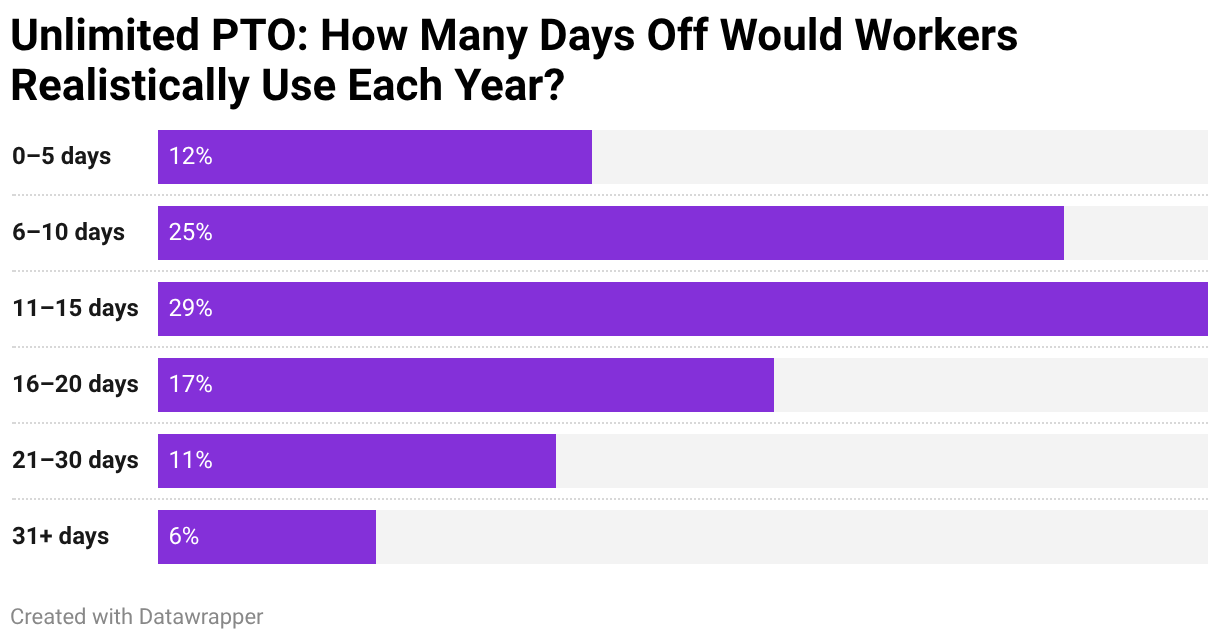
Two-thirds of workers would still cap themselves at 15 days or fewer, even without a formal limit. Among Gen Z, nearly half would take 10 days or less.
The restraint reflects something cultural. In workplaces shaped by performance metrics, layoffs, and constant connectivity, “unlimited” can feel ambiguous. Without a defined number, employees look to managers and peers for cues. If leadership doesn’t model extended breaks, the safest move is often to take less time off.
High earners appear to recognize the dynamic: 25% of those making $150,000 or more believe unlimited PTO sounds generous but results in people taking less time off.
Freedom without boundaries can create uncertainty instead of relief.
Why workers prefer guardrails
If unlimited PTO removes structure, employees seem eager to put some back.
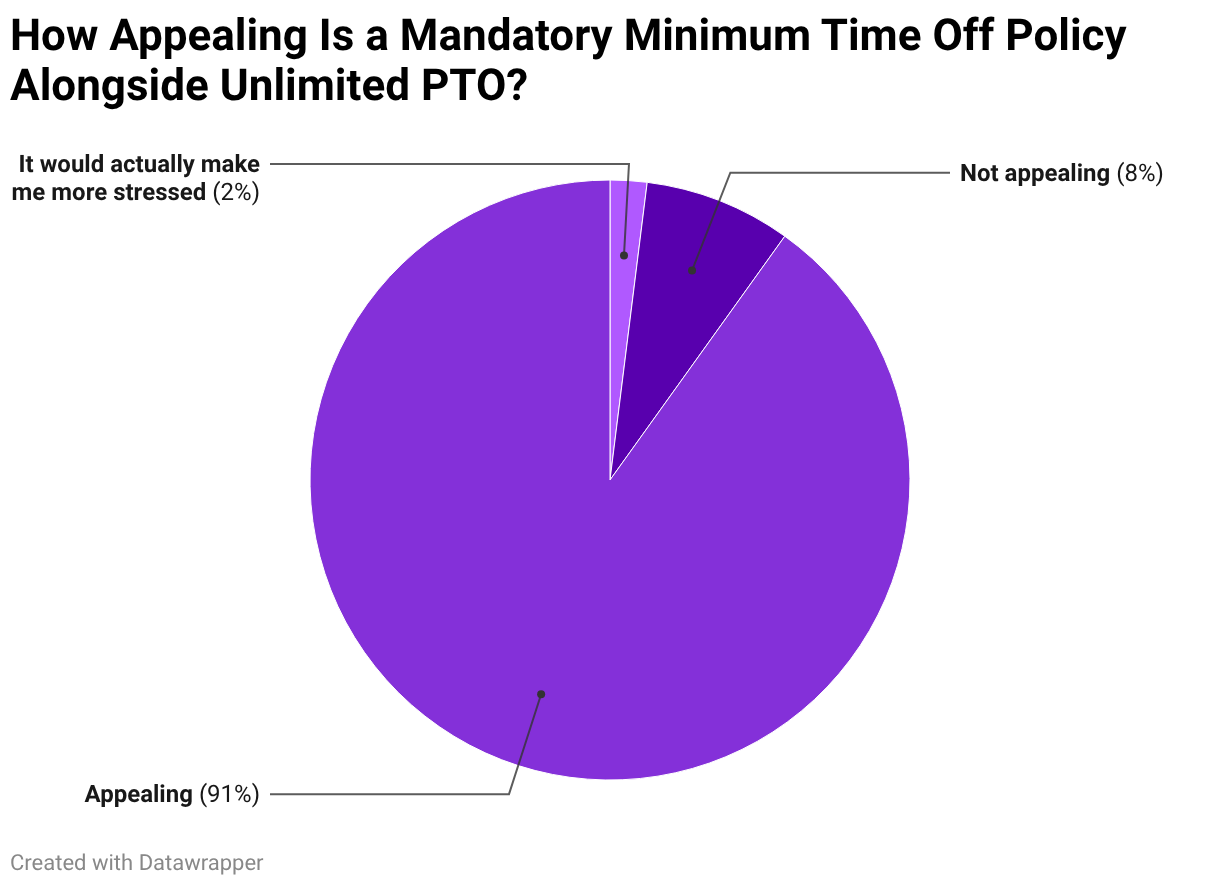
An overwhelming 91% say a mandatory minimum time-off policy paired with unlimited PTO is appealing. The appeal is simple: a required baseline sets expectations and removes guilt.
Two-thirds also say a fair annual PTO allowance is 11 days or more. That figure is not extravagant. It reflects a desire for predictability. A number on paper offers something unlimited policies often do not: clarity.
In an era where burnout has become normalized, structure feels stabilizing.
Fairness, responsibility, and the gender divide
When PTO policies lack flexibility or clarity, fairness becomes another concern. Perceptions of PTO fairness vary by gender.
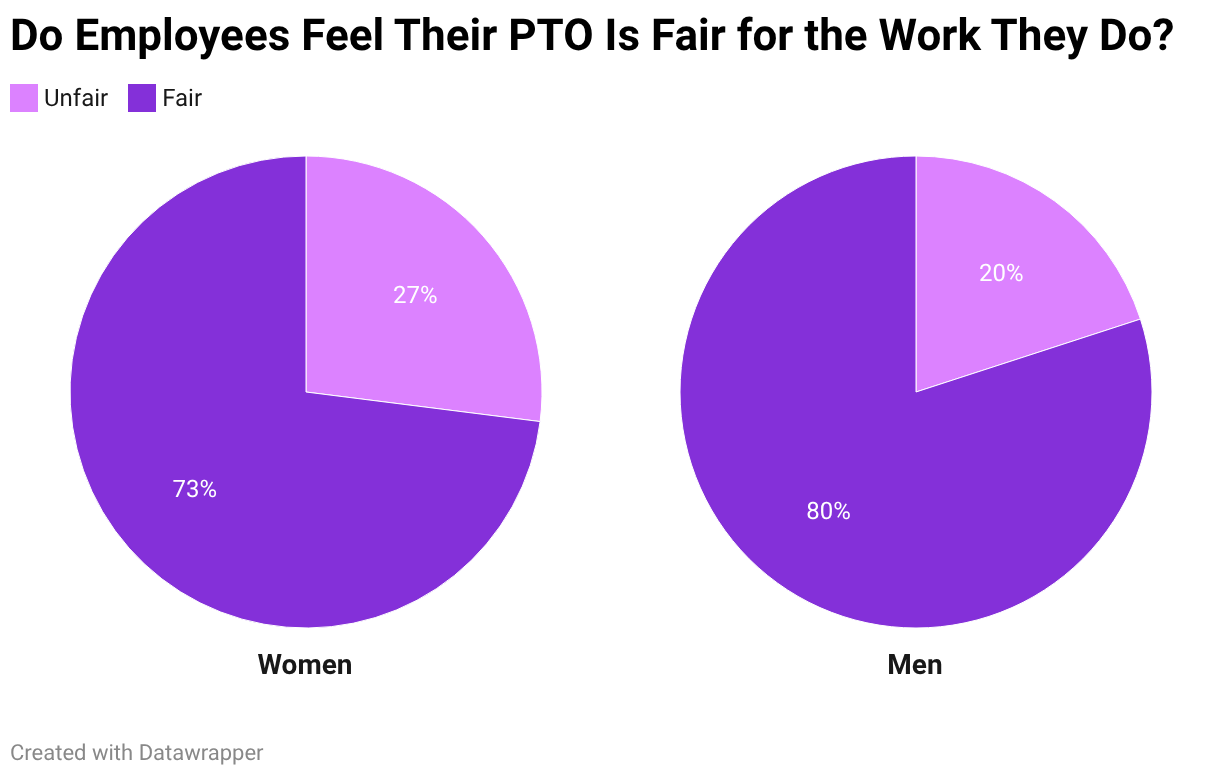
More than a quarter of women (27%) say their current PTO feels unfair given the work they do. Among men, that number drops to 20%.
Time off often covers more than vacations. It absorbs sick days, school closures, elder care, and medical appointments. When responsibilities outside of work expand, static PTO policies can feel misaligned with reality.
The gap reflects ongoing conversations about caregiving responsibilities and the unseen work that takes place outside the office, such as coordinating medical appointments and managing family schedules. For some employees, PTO isn’t a bonus benefit. It’s the time they rely on to handle real-life demands that don’t pause during business hours.
Millennials are feeling the financial strain of limited PTO
For many workers, unclear or limited PTO policies don’t just create uncertainty. They can create financial pressure. For millennials, running out of PTO isn’t theoretical.
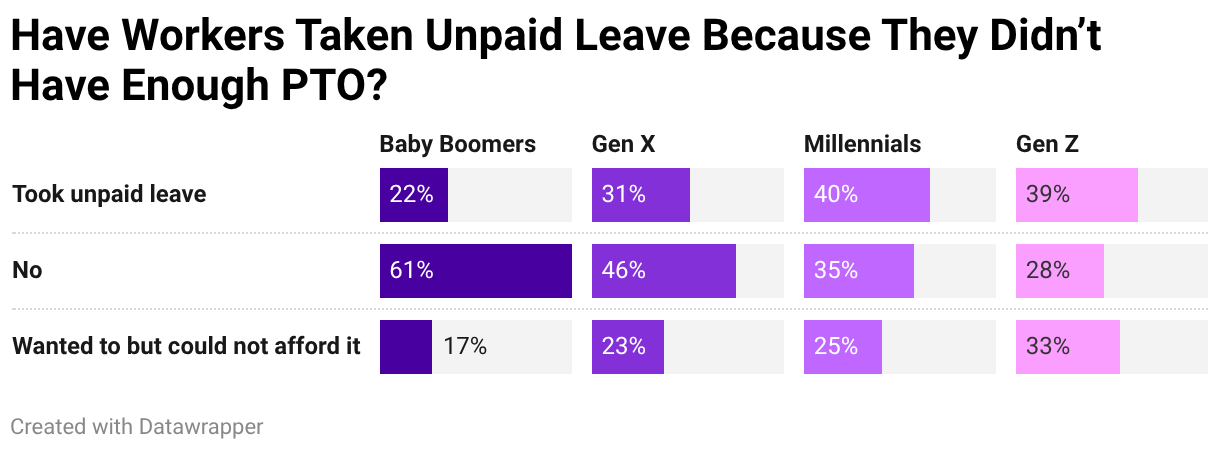
Forty percent say they’ve taken unpaid leave after exhausting their PTO. Another 25% say they needed unpaid time off but couldn’t afford to lose the income.
These are prime caregiving years. Many are raising young children, supporting aging parents, or juggling both. Life interruptions are common. Sick days, school closures, and medical appointments add up quickly.
When paid time runs out, the choice becomes straightforward but difficult: Stay home and lose pay, or keep working and let something else suffer.
For households already managing childcare costs, student loans, and rising living expenses, unpaid leave isn’t a small inconvenience. It can disrupt a monthly budget.
In that context, PTO stops feeling like a vacation benefit. It becomes a safety net. And when that safety net runs thin, the pressure shows.
Baby Boomers and the structure gap
Baby Boomers report the highest level of confusion about unlimited PTO, with 44% saying it creates the most uncertainty for employees, the highest among generations.

This likely reflects a familiarity gap. Baby Boomers entered the workforce during an era of clearly defined benefits: a set number of vacation days, predictable accrual schedules, and formal leave policies. Unlimited PTO inverts that structure entirely. Without a number to anchor expectations, the policy can feel less like a benefit and more like an open question.
For a generation that built careers around clearly defined rules, ambiguity is not freeing. It is unsettling.
Gen Z, by contrast, reports confusion at a lower but still notable rate (36%). Younger workers tend to push back on the lack of transparency. They expect clear metrics and defined systems. When PTO policies lack clear numbers or consistent explanations, they notice.
Across generations, the pattern holds: flexibility appeals. Ambiguity does not.
PTO as a measure of trust
At its core, paid time off signals more than rest. It signals trust.
It reflects whether employees can step away without risking negative perception. It communicates whether work-life balance is a cultural reality or corporate language.
Patriot Software’s CEO Kyle Dreger, shared:
Encouraging PTO use comes down to two things: employers who respect their team’s time enough to say ‘step away,’ and employees who trust their workplace enough to actually do it.”
The survey suggests workers are not questioning the value of PTO itself; rather, they are questioning whether they can take advantage of it.
They want to know how much time they have, how it accrues, whether unused days roll over, and what happens when they use it. When those answers are transparent, PTO functions as intended.
When they are not, time off becomes another uncertainty to manage.
Methodology
To understand how Americans interpret and navigate their paid time off benefits, we surveyed 1,000 employed adults across the United States. Participants answered questions about PTO structure, fairness expectations, behavior under unlimited policies, and experiences with unpaid leave. Responses were analyzed by age, income, and gender.
Fair use policy
Users are welcome to utilize the insights and findings from this study for noncommercial purposes, such as academic research, educational presentations, and personal reference. When referencing or citing this article, please ensure proper attribution to maintain the integrity of the research. Direct linking to this article is permissible, and access to the original source of information is encouraged.
For commercial use or publication purposes, including but not limited to media outlets, websites, and promotional materials, please contact the authors for permission and licensing details. We appreciate your respect for intellectual property rights and adherence to ethical citation practices. Thank you for your interest in our research.
This article has been updated from its original publication date of March 13, 2026.
This is not intended as legal advice; for more information, please click here.