
A new Patriot Software survey of 1,000 U.S. adults who voluntarily switched jobs in the past five years found that 59.9% believe staying at one company for five or more years actively hurts their earning potential. Among Gen Z, that number climbs to 70.4%. These job hoppers’ personal experiences back up that belief: 60.6% of switchers in this survey captured double-digit raises by walking out the door.
- 59.9% of workers believe company loyalty comes with a financial penalty
- 63.2% have had to quit a job just to get the salary they felt they deserved
- 93% would take some form of action if they found out their employer pays new hires more than loyal staff
- 49.6% were told they were excellent in a performance review and still got a below-average raise
- Only 35.9% wait until they’ve mentally already quit before looking for a new job
- 50.8% did not receive a counteroffer or conversation about retention when they said they were leaving
- 69.1% have zero regrets about the job switches they’ve made in the past five years
Majority of workers believe staying at one job hurts earning potential

The “loyalty tax” has been a documented reality for years: tenured employees at high-paying companies earn less than new hires in 83% of cases.
ThePatriot Software survey reflects this:
- 59.9% believe staying at one company long-term hurts their earning potential.
- Of that group, 16.6% say loyalty is absolutely punished.
- 43.3% of the same group say internal raises simply can’t keep pace with the market.
The loyalty discrepancy shows up across generations. 70.4% of Gen Z and 65.6% of Millennials say loyalty is punished, compared to 51% of Gen X and 40.4% of Baby Boomers.
Gen Z and Millennials have navigated rapid labor market changes including pandemic shutdowns, the post-2020 hiring boom, the AI shift, and limited entry-level job opportunities. As a result, Gen Z and Millennial employees have relied on job hopping to increase raises and job security.
93% of workers would take action if they were underpaid

When asked what they’d do if their employer paid new hires more than loyal, experienced employees, the responses were striking::
- 31.1% would start job searching immediately
- 37.2% would quietly update their resume and wait for the right opportunity
- 24.7% would confront their manager directly
- Only 7% said they would accept it and move on
More often than not, workers won’t say anything at all. Quietly updating the resume was the top response across nearly every major demographic: Millennials, Gen X, Baby Boomers, college-educated workers, anyone earning above $50,000, and parents.
Among $250K+ earners, 63.6% said they would quietly update their resume rather than confront leadership. These are senior employees with leverage and institutional knowledge who, faced with evidence of being underpaid, won’t raise their hand. They’ll just leave.
Half of workers were told they were excellent, then handed a raise that said otherwise

49.6% of respondents say they received a strong performance rating that wasn’t reflected in their compensation increase.
What makes this finding unusual is how evenly it lands. Every demographic group surveyed reports the same experience at roughly the same rate:
- $100K–$249K earners: 56.4%
- Postgraduate professionals: 55.1%
- Parents with kids under 18: 52.8%
- Gen Z: 52.8%
- Men: 54.9%
The performance-review-to-raise gap isn’t a corporate problem, a generational problem, or a high-earner problem. It’s a universal issue.
Roughly two-thirds of the workforce has some engagement with the job market

It’s traditionally assumed that most employees are either actively job searching or happily employed. But the survey results show otherwise:
- 20.5% have an active saved job search and check it constantly
- 35.4% apply to roles occasionally to keep their interview skills sharp, even when they’re happy
- 8.2% use competing offers as leverage with no actual plan to leave
- Only 35.9% wait until they’ve mentally quit to start looking
When asked why they walked out the door, 26.1% said they found a better opportunity and jumped on it. Toxic management, no growth left in the position, and insulting pay were other reasons for job separation.
Workers have named their price, but employers haven’t met the number

When asked what it would realistically take to stay at their current job for five more years, 56.4% of workers said a salary increase of at least 20%.
When asked how large a counteroffer would have to be to actually stop them from leaving, 37.6% said 20% – 29%, and 13.8% said nothing less than 30%. The national average raise is 3%, substantially lower than the 20% – 30% employees are looking for to stay.
Half of workers walk out with no counteroffer

50.8% of respondents say their employer made no retention effort when they left. Of the workers who do receive a counteroffer, only 16.2% accept and stay long-term. Counteroffers sometimes work for those who get them; the harder problem is that most workers never get one.
Workers have noticed the pattern:
- 46.3% say the most common employer mistake is waiting until someone is walking out the door to offer more money.
- Another 46.3% say employers ignore burnout until someone breaks.
- 47.1% say the most consistent failure is promoting the wrong people.
All three failures point to the same underlying pattern: companies act on compensation, burnout, and promotion decisions only after a problem has become a crisis. By then, the worker is already calculating their exit.
Most workers who left would do it again
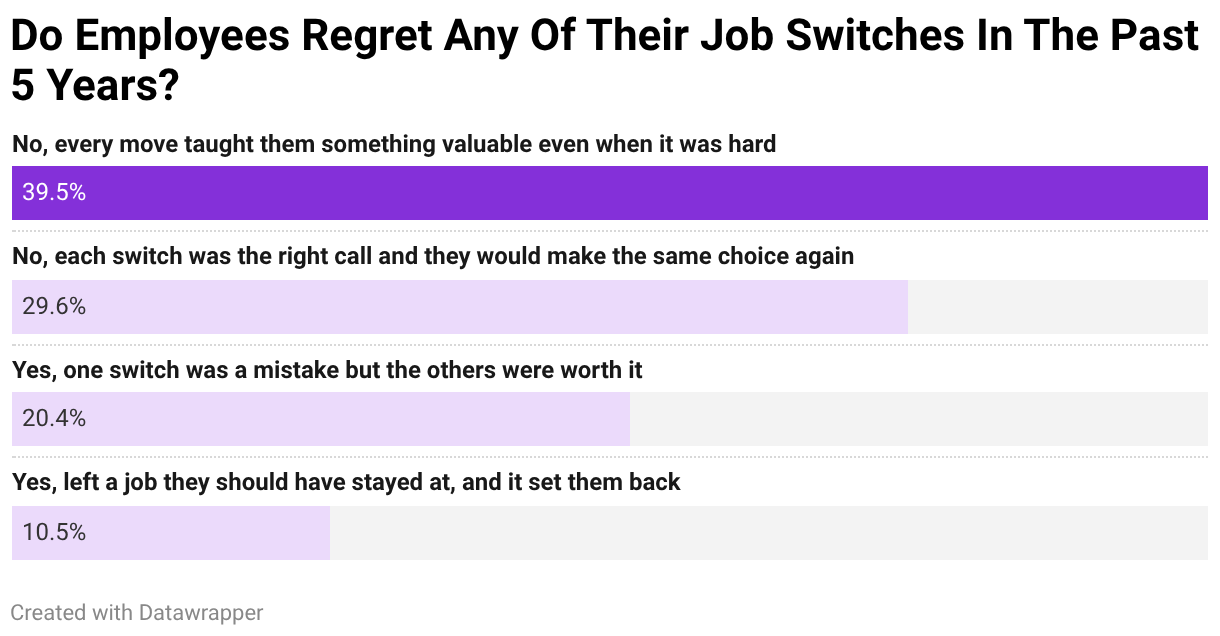
69.1% of people who have switched jobs have no meaningful regrets about their moves:
- 39.5% say every move taught them something valuable, even when it was hard.
- 29.6% say every switch was the right call.
- Among Baby Boomers, the generation least associated with job hopping, 83% have no regrets.
There’s a cultural anxiety that job hopping signals instability to future employers. However, only 34.3% of respondents believe employers view job hoppers as red flags. An identical 34.3% say employers view them as neutral.
The workers in this survey are running toward better terms, and for 60.6% of them, the moves came with double-digit raises.
Summary
As a result of lower-than-expected raises and missed retention conversations, workers have learned that job hopping often paves the way to significantly higher pay.
The majority of surveyed workers agree that rewarding loyal workers with higher raises would eliminate the increase in job hopping.
Methodology
To understand how Americans approach job switching, loyalty, and compensation, Patriot Software surveyed 1,000 U.S. adults who have voluntarily switched jobs in the past five years. Respondents who stayed at one employer for five years were screened out to focus the study on active job switchers. Participants answered a series of questions about why they left previous roles, what they earned by switching, what would convince them to stay, and how they view their employers’ compensation and retention practices. Responses were analyzed across demographic groups including job mobility, age, gender, household income, education, and parental status to identify trends and disparities in how different segments of the American workforce experience the modern labor market.
Fair use policy
Users are welcome to utilize the insights and findings from this study for noncommercial purposes, such as academic research, educational presentations, and personal reference. When referencing or citing this article, please ensure proper attribution to maintain the integrity of the research. Direct linking to this article is permissible, and access to the original source of information is encouraged.
For commercial use or publication purposes, including but not limited to media outlets, websites, and promotional materials, please contact the authors for permission and licensing details. We appreciate your respect for intellectual property rights and adherence to ethical citation practices. Thank you for your interest in our research.
This is not intended as legal advice; for more information, please click here.