
Help, I can’t pay my employees! If this thought has ever crossed your mind, you know how scary it can be. Realizing you can’t make payroll might make you feel anxious, embarrassed, and helpless.
But, it doesn’t have to.
There are a number of things you can do if you can’t make payroll that could help you pay employees on time.
Quick answer: Can you legally pay employees late?
Short answer: Generally no. Under the Fair Labor Standards Act (FLSA), nonexempt employees must be paid all earned wages on their regular payday. Most states add stricter rules and penalties. If a payment will be late, pay as soon as funds are available, document the reason, correct the issue immediately, and check state rules for any additional penalties you may owe.
Key risks of paying late:
- Back wages plus liquidated damages (often doubling what’s owed)
- State civil penalties, interest, and potential criminal exposure for willful or repeated violations
- IRS penalties if payroll taxes are late (separate from wages)
- Employee complaints, turnover, and reputational harm
Immediate next step if you’ll miss payday:
- Notify employees before payday with a firm makeup date and payment method.
- Run an off-cycle payroll and expedite direct deposit when funds clear.
- Contact state labor authorities or a small business lawyer for your state’s requirements.
4 Reasons making payroll might be difficult
Payroll is the biggest expense for many small business owners. In addition to an employee’s salary or wages, you have benefits and taxes you’re responsible for. And if something goes wrong in your cash flow, footing the bill for payroll might not be feasible on your own.
Here are a few situations that could prevent you from being able to afford the high payroll price tag, such as:
- Three-paycheck months: Do you pay employees biweekly? If so, there are two months per year that you have to give the employee three paychecks as opposed to two. You might not have enough cash to cover the third paycheck if you forget to account for it in your budget.
- Natural disasters: A natural disaster (e.g., hurricane, tornado, earthquake, or fire) can close down operations and destroy property. It could prevent you from earning enough to cover your losses and cover payroll.
- High accounts receivable: Do you have customers who won’t pay? If so, you likely have high accounts receivable (AR). These receivables could be jamming up your cash flow and making it difficult to pay for your own liabilities.
- Low sales: You will likely go through periods where your sales are low, whether you’re a seasonal business or not. Maybe a large sale fell through. Or, maybe the economy is in a recession. Low sales could be the culprit for not being able to make payroll.
Whatever the case may be, you’re not the only business owner who has struggled to make payroll.
Why paying employees on time matters
It’s important to get employees their earned wages on time. Why? To start, 78% of Americans live paycheck to paycheck, according to one survey.
So if you can’t make payroll, your employees may not be able to pay their own bills, kicking off a vicious cycle. Not to mention, late paychecks could decrease employee effort and morale.
As if that wasn’t bad enough, not making payroll could also kickstart some legal problems for your small business. The Fair Labor Standards Act (FLSA) requires employers to pay non-exempt employees on their regularly scheduled payday. If you don’t, you could be in violation of the FLSA, according to the Department of Labor.
When you violate the FLSA, you might have to pay back wages, back taxes, criminal penalties, damages, attorney’s fees, and court costs. You could also face imprisonment. All of this will cost you much more than if you paid employees on time.
In addition to federal laws on paying employees on time, your state might also set its own rules. For example, there are pay frequency requirements by state that require employers to pay employees within a certain time frame. Consult your state labor department to find out if your state has any additional regulations for employers who can’t make payroll.
Legal obligations at a glance
Federal: FLSA requires timely payment of all hours worked to nonexempt employees on the regular payday. Late payment can trigger back wages and liquidated damages, plus attorney fees if claims are filed.
States: Many states add penalties. Check your state laws for specifics. For example:
- California: Waiting time penalties (up to 30 days’ wages) for certain late/final pay; misdemeanor in some willful cases.
- Illinois: 5% monthly interest on underpaid wages plus civil penalties.
- Rhode Island: A fine of up to $5,000 and/or imprisonment for up to three years for knowingly and willfully failing to pay wages of more than $1,500.
What to do if you can’t make payroll
Again, there are alternatives if you can’t afford to pay your employees their paychecks. But before we get into those, your first task is to admit you can’t make payroll to your employees.
Odds are, there are signs in advance that you will come up short on payday. You can often see your business’s accounts draining to zero. The sooner you tell employees, the more time they will have to prepare.
Tell employees about the alternatives you plan to pursue. Let them know how you plan to pay them and what steps you are going to take to get the business back on track. If employees should begin looking for other work, you need to tell them this, too.
You do have something to your advantage that big businesses don’t have. Small businesses often feel like family. You and your employees might know each other well. This family environment could make employees more willing to stay by your side during this turbulent time.
Immediate steps (within 24-48 hours)
- Communicate before payday: Share the reason, the exact make-up pay date, and the payment method (off-cycle check, expedited direct deposit, etc.).
- Prioritize payroll funds: Separate payroll and payroll tax funds from other expenses.
- Run an off-cycle payroll as soon as funds clear: Do not wait for the next regular payday.
- Document everything: Keep a record of the issue and correction date.
- Check state rules: Determine if additional penalties or forms apply (e.g., waiting-time penalties).
Sample message to employees
Here’s an example of a simple message you can send to employees if there’s a payday delay:
“I’m sorry to share that Friday’s payroll will be delayed due to [brief reason]. You will receive full payment of wages for [pay period dates] on [make-up date] via [method]. Overtime and any reimbursements will be included. We’re taking steps to prevent this from happening again, including [brief step]. If you have questions, please contact [HR/owner name].”
Alternative funding options for payroll
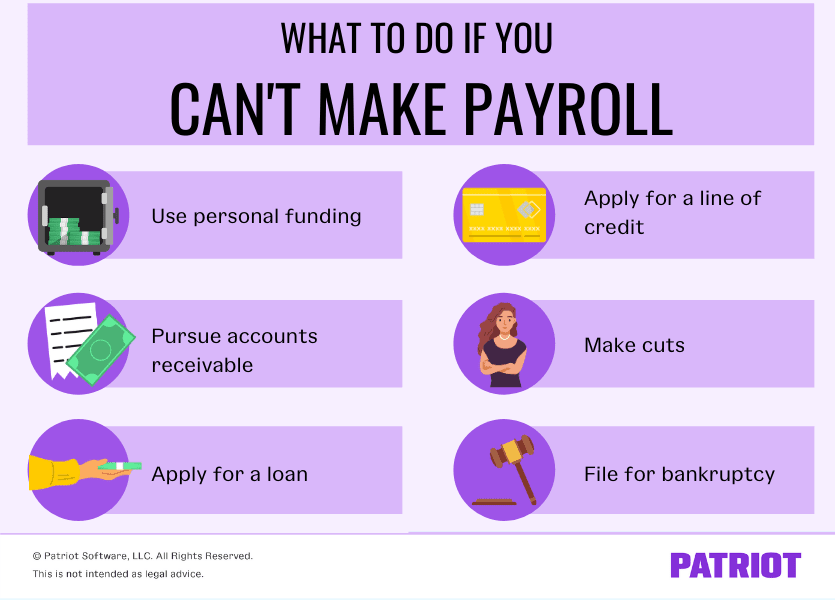
So if you can’t make payroll, you may need to consider the following alternatives:
- Use personal funding
- Pursue accounts receivable
- Apply for a small business loan
- Apply for a line of credit
- Make cuts
- File for bankruptcy
What you pursue depends on your specific situation. Figure out how much money you need. This might help you determine how drastic your financing methods need to be. Remember, part of payroll is paying taxes, so you need money for that too.
1. Use personal funding
If worse comes to worst and you can’t make payroll, look at your personal savings. Can your family afford to invest some money to help your business pay your employees?
If you are able to use your personal savings to fund part of your payroll expenses, determine how much more you need to make ends meet.
2. Pursue accounts receivable
Look at your accounts receivable. Do you have any customers who owe you money?
Customers might be willing to make a payment sooner if you offer an incentive, like an early payment discount. Although this causes you to lose money, it might help you to get paid faster. This is a trade-off that you might have to make if you can’t make payroll.
If customer payments are well overdue, and you’ve exhausted your efforts asking for payment, you might hire a collection agency.
If timing is the main issue, consider invoice factoring or invoice financing to unlock a portion of outstanding invoices quickly. These options can fund within days, though they come with fees and may not be ideal long-term.
3. Apply for a small business loan
You can try to get a traditional bank loan or a Small Business Administration (SBA) loan. You might also consider asking friends and family for financial help in the form of a payroll loan. Someone could be willing to loan you money with more generous terms than you can find from a traditional lender.
Getting a traditional bank loan can take significant time and energy, which might make it difficult to rely on for making payroll. But some online lending services, like BlueVine, may have a faster turnaround time.
4. Apply for a line of credit
Another option you have for making payroll is to apply for a business line of credit. You can apply for a secured (collateral, lower interest rates) or an unsecured (no collateral, higher interest rates) line of credit.
5. Make cuts
You might have to make pay cuts if you can’t make payroll. First, look at your own earnings. You can suspend your compensation until your business is back on its feet. This also shows your employees that they aren’t the only ones taking a financial hit.
You could reduce the hours employees work, which will reduce their earnings. You can do this by reducing everyone’s scheduled hours, furloughing employees, or asking them to volunteer to take time off.
Remember to pay employees at least the minimum wage to stay compliant with the FLSA.
6. File for bankruptcy
If your business continually struggles to make payroll due to large amounts of debt and low revenue, you may consider filing for bankruptcy.
There are a few bankruptcy options that businesses have, including Chapters:
- 7: Liquidation
- 11: Reorganization
- 13: Court-approved repayment plans
Generally, employees receive priority payment for unpaid paychecks through bankruptcy.
Compliance reminders if a paycheck will be late
- Pay as soon as funds are available (don’t wait for the next cycle)
- Include all hours worked, overtime, and any required penalties (state-dependent).
- Final pay is different: Many states require faster timelines for terminated employees.
- Payroll taxes have separate, strict deposit deadlines. Late payroll taxes can trigger IRS penalties (often 2–15%) and personal liability in some cases.
- Keep proof of payment and communication with employees.
How to prevent the problem in the future
Stressing about making payroll can feel like you’re trapped in a nightmare. When you take advantage of an alternative to run payroll when you can’t afford it, your work isn’t over. It is essentially a small patch on a damaged ship. Make lasting changes before you sink into business wreckage.
If you want to avoid the problem in the first place, consider doing the following:
- Examine your spending habits
- Speed up accounts receivable
- Improve sales
- Create an emergency fund
- Consult an accountant
Take a thorough look at your business’s spending habits. Consider your overhead expenses. Identify all your cash flow problems. You might need to restructure parts of your business.
If your business has an accounts receivable payment policy, look at it. If your policy is too lenient, you might not get receivables in a timely fashion. You will have cash flow problems when customers take a long time to pay you. And, cash flow problems mean you will have less money for payroll and bills.
If you aren’t making enough sales, you might want to do a market analysis. A market analysis can help you understand your customers, competitors, and industry. You can then adjust your goods or services to be more desirable.
For future financial emergencies, build up your business’s savings now. One way to do this is to commit to putting a certain percentage of your business’s income into an emergency fund.
As you prepare your business for the future, you might want to consult an accountant. An accountant can help you understand where your money is going so you can make informed business decisions.
Practical targets to reduce risk:
- Build a payroll reserve equal to 1–2 payroll cycles.
- Tighten accounts receivable. Set clear payment terms, apply late fees where allowed, and send automated reminders periodically.
- Forecast cash weekly. Flag upcoming three-paycheck biweekly months in your budget.
Payroll solutions to consider
A reliable system can help you forecast payroll cash needs, automate calculations, and reduce last-minute surprises.
Patriot’s online payroll is fast, simple, and affordable with free USA-based support. Patriot’s unlimited payrolls lets you run off-cycle payrolls without paying extra. Plus, the Full Service Payroll option handles federal, state, and local payroll tax filings and deposits for you so you can stay on schedule and compliant.
FAQs
Generally no. The FLSA and state laws require timely payment. Pay as soon as possible, communicate in writing, and check your state’s penalties.
Back wages, liquidated damages (often doubling wages owed), interest, state civil fines, and in willful/repeat cases, potential criminal exposure. Some states (e.g., California) impose additional waiting-time penalties or double wages.
Yes. The IRS can assess penalties and interest for late deposits (often 2–15%), and responsible individuals can face personal liability in some cases.
Issue paper checks or same-day electronic alternatives immediately and cover any bank charges employees incur due to your error. Document the fix and cause.
Often accounts receivable-related options (invoice factoring/financing) or an existing business line of credit can provide quick funding. Costs vary. Use payroll funding options as short-term bridges, and address root cash flow issues.
Need a reliable way to run payroll that won’t break the bank? Patriot’s online payroll is fast, simple, and affordable; provides free, USA-based support; and comes with a free trial so you can see for yourself. Start your free trial today!
This article has been updated from its original publication date of February 24, 2016.
This is not intended as legal advice; for more information, please click here.