
Remote work may have taken the nation by storm during the pandemic, but it isn’t evenly distributed across the USA. For example, Colorado and Massachusetts have a significantly higher remote-work rate than Mississippi and Alabama.
Using Bureau of Labor Statistics (BLS) data, we’ll explore which states have the highest and lowest telework rates and why.
Key takeaways
- In 2023, approximately 30.6 million U.S. workers reported teleworking, which is about 19.7% of all workers nationally.
- Washington D.C. ranks #1 for remote work adoption with 56.5% of people teleworking for pay. Of this, 23.4% of people telework all hours and 33.1% telework some hours.
- 31.7% of people telework in Colorado, making it the state with the highest telework rate.
- Only 4.7% of employees telework some or all hours in Mississippi, the lowest percentage in the country.
- Colorado, Massachusetts, and Washington have the most teleworkers.
- Mississippi, Alabama, and Arkansas have the fewest teleworkers.
- Education level plays a key role in teleworking: Only 9.8% with a high school diploma or less work remotely, compared to 35.2% of those with a Bachelor’s degree and higher.
- Legal is the occupational group most likely to have telework available, with 50.1% of legal jobs being remote.
- Construction, healthcare support, and maintenance are occupations with the lowest remote work opportunity.
Skip Ahead
- What does the BLS data measure?
- Remote work map
- Remote workers by state chart
- What state has the most remote workers?
- What state has the fewest remote workers?
- How many Americans work remotely?
- What percent of Americans work from home?
- What jobs have the most remote work opportunities?
- Does education impact remote work opportunities?
- Why does remote work differ so much by state?
- What are the pros and cons of remote work?
- What to do if you have remote employees
What does the BLS data measure?
Between the rise of remote work during the pandemic and return-to-work mandates after, the work landscape has changed drastically.
The BLS data tracks teleworking by:
- State
- Age
- Sex
- Education level
- Disability status
- Worker status (full time or part time)
- Occupation
You can find the full 2023 annual teleworking by state data here. You can find all first quarter 2023 and 2024 demographic data here. All 2021 telework by occupational group data is here.
Remote work map
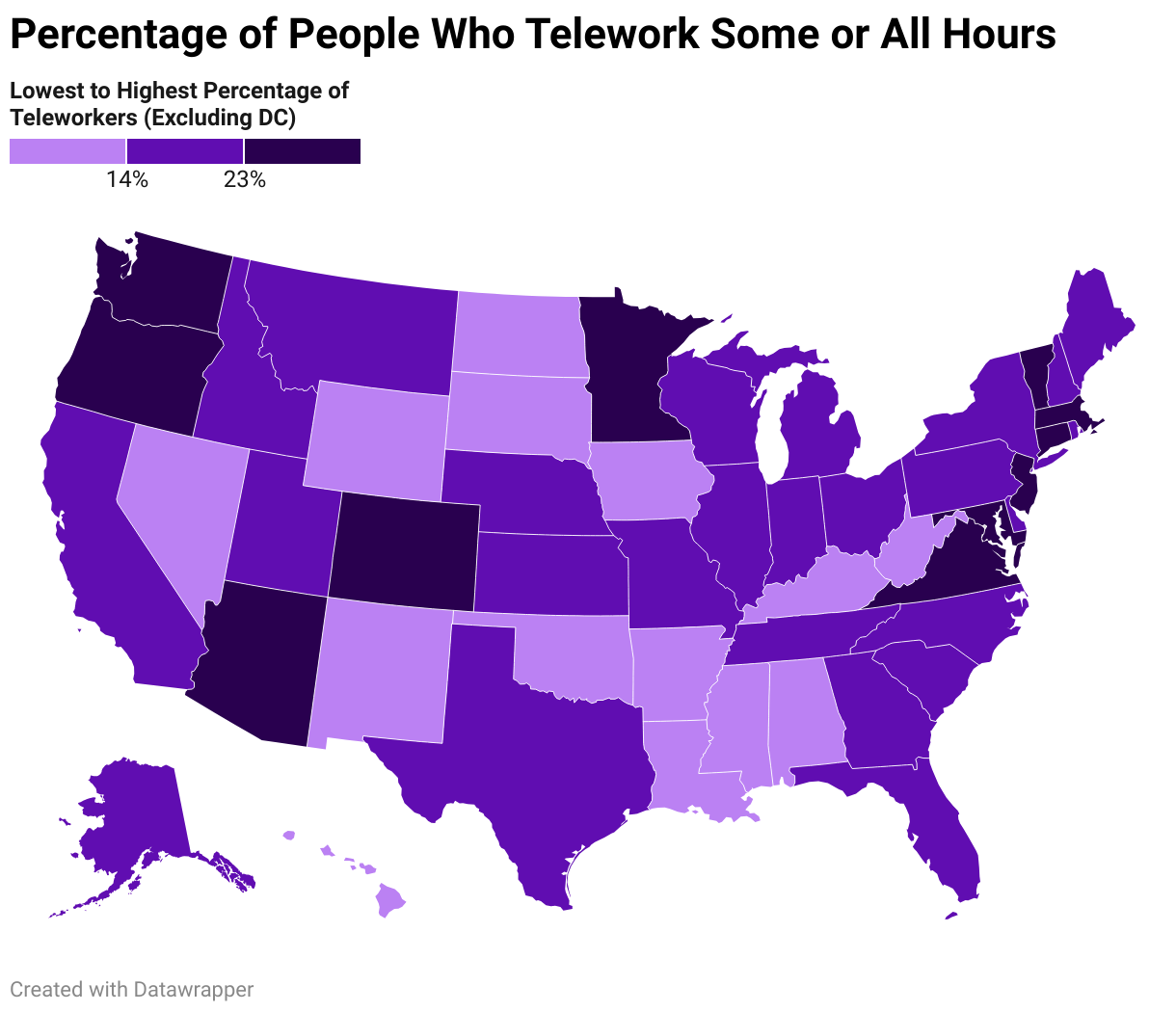
A quick glance at the map below makes one thing clear: remote work is a bigger trend in some states than others. High telework rates are more common in states with strong tech, finance, and professional service jobs. Many states in the South and Midwest trails have lower telework rates due to more manufacturing, agriculture, and construction jobs.
Remote workers by state chart
The number of employees who telework varies significantly across the United States. Although the national teleworking rate is 19.7%, state rates range from 4.7% to 56.5%.
Use the chart below to see the percentage of teleworkers by state.
| State | % Who Telework Some or All Hours | % Who Telework Some Hours | % Who Telework All Hours | % Who Do Not Work at Home |
|---|---|---|---|---|
| Alabama | 7.7% | 3.0% | 4.6% | 92.3% |
| Alaska | 13.9% | 7.8% | 6.1% | 86.1% |
| Arizona | 23.9% | 10.0% | 13.9% | 76.1% |
| Arkansas | 9.0% | 3.9% | 5.1% | 91.0% |
| California | 22.6% | 11.5% | 11.1% | 77.4% |
| Colorado | 31.7% | 16.0% | 15.8% | 68.3% |
| Connecticut | 25.1% | 14.4% | 10.7% | 74.9% |
| Delaware | 20.6% | 10.5% | 10.0% | 79.4% |
| D.C. | 56.5% | 33.1% | 23.4% | 43.5% |
| Florida | 15.3% | 5.3% | 10.0% | 84.7% |
| Georgia | 17.8% | 6.9% | 10.9% | 82.2% |
| Hawaii | 12.8% | 6.5% | 6.4% | 87.2% |
| Idaho | 15.1% | 7.2% | 8.0% | 84.9% |
| Illinois | 20.9% | 11.2% | 9.7% | 79.1% |
| Indiana | 14.8% | 7.4% | 7.4% | 85.2% |
| Iowa | 12.2% | 5.6% | 6.6% | 87.8% |
| Kansas | 16.4% | 8.0% | 8.5% | 83.6% |
| Kentucky | 13.2% | 6.6% | 6.6% | 86.8% |
| Louisiana | 9.5% | 4.0% | 5.5% | 90.5% |
| Maine | 21.7% | 10.1% | 11.6% | 78.3% |
| Maryland | 27.6% | 13.0% | 14.6% | 72.4% |
| Massachusetts | 29.4% | 16.1% | 13.3% | 70.6% |
| Michigan | 20.5% | 10.2% | 10.3% | 79.5% |
| Minnesota | 25.2% | 12.7% | 12.4% | 74.8% |
| Mississippi | 4.7% | 1.6% | 3.1% | 95.3% |
| Missouri | 16.9% | 7.6% | 9.3% | 83.1% |
| Montana | 16.0% | 7.2% | 8.8% | 84.0% |
| Nebraska | 17.2% | 8.5% | 8.7% | 82.8% |
| Nevada | 13.1% | 5.1% | 7.9% | 86.9% |
| New Hampshire | 22.4% | 10.4% | 12.0% | 77.6% |
| New Jersey | 24.3% | 13.1% | 11.2% | 75.7% |
| New Mexico | 13.0% | 5.8% | 7.2% | 87.0% |
| New York | 19.3% | 10.7% | 8.6% | 80.7% |
| North Carolina | 18.5% | 8.2% | 10.4% | 81.5% |
| North Dakota | 11.3% | 5.3% | 6.0% | 88.7% |
| Ohio | 18.7% | 9.4% | 9.3% | 81.3% |
| Oklahoma | 11.0% | 5.7% | 5.3% | 89.0% |
| Oregon | 26.2% | 12.1% | 14.1% | 73.8% |
| Pennsylvania | 21.1% | 10.2% | 11.0% | 78.9% |
| Rhode Island | 19.2% | 9.4% | 9.9% | 80.8% |
| South Carolina | 14.1% | 5.8% | 8.3% | 85.9% |
| South Dakota | 9.4% | 4.0% | 5.5% | 90.6% |
| Tennessee | 15.3% | 6.8% | 8.5% | 84.7% |
| Texas | 18.4% | 7.7% | 10.7% | 81.6% |
| Utah | 21.8% | 9.8% | 12.0% | 78.2% |
| Vermont | 22.7% | 10.8% | 11.8% | 77.3% |
| Virginia | 27.3% | 13.3% | 13.9% | 72.7% |
| Washington | 28.5% | 14.0% | 14.5% | 71.5% |
| West Virginia | 9.4% | 4.2% | 5.2% | 90.6% |
| Wisconsin | 16.5% | 8.0% | 8.4% | 83.5% |
| Wyoming | 10.2% | 5.1% | 5.1% | 89.8% |
What state has the most remote workers?
At 56.5%, Washington D.C. has the most remote workers according to the most recent BLS data. However, this may have shifted in 2025 due to the return to in-person work mandate for federal workers.
Colorado is the state with the most remote workers at a 31.7% telework rate.
Excluding Washington D.C., here are the top 10 states for telework:
- Colorado at 31.7%
- Massachusetts at 29.4%
- Washington at 28.5%
- Maryland at 27.6%
- Virginia at 27.3%
- Oregon at 26.2%
- Minnesota at 25.2%
- Connecticut at 25.1%
- New Jersey at 24.3%
- Vermont at 22.7%
What state has the fewest remote workers?
Mississippi has the fewest teleworkers at a rate of 4.7%. And, only 3.1% telework all hours in the state.
Here are the 10 states with the lowest telework rates:
- Mississippi at 4.7%
- Alabama at 7.7%
- Arkansas at 9.0%
- Louisiana at 9.5%
- West Virginia at 9.4%
- South Dakota at 9.4%
- Wyoming at 10.2%
- Oklahoma at 11.0%
- North Dakota at 11.3%
- Hawaii at 12.8%
How many Americans work remotely?
Nationally, 30.6 million Americans telework some or all of the time. Of that number, about 14.6 million telework some hours and about 16 million telework all hours.
What percent of Americans work from home?
Nationally, 19.7% of Americans telework some or all of the time. Of that rate, 9.4% telework some hours and 10.3% telework all hours.
What jobs have the most remote work opportunities?
Industries like legal, computer, and business operations have more teleworking opportunities than industries such as construction, healthcare support, and maintenance.
According to the BLS, the following occupational groups are most likely to have telework opportunities:
| Occupation | Telework Available |
|---|---|
| Legal | 50.1% |
| Computer and mathematical | 47.6% |
| Business and financial operations | 40.8% |
| Management | 29.6% |
| Architecture and engineering | 29.3% |
| Arts, design, entertainment, sports, and media | 27.3% |
| Life, physical, and social science | 16.7% |
| Community and social service | 12.5% |
| Sales and related | 10.2% |
On the flip side, telework opportunities were least likely to be available in industries such as building and grounds cleaning and maintenance, construction, library, healthcare support, maintenance, production.
Does education impact remote work opportunities?
Yes, education level significantly impacts remote work. For example, 35.2% of those with Bachelor’s degrees and higher telework, compared to only 9.8% of those with a high school diploma or less.
| Education Level | Percent of People Who Telework |
|---|---|
| Bachelor’s degree and higher | 35.2% |
| Some college or associate degree | 15.3% |
| High school graduates | 7.3% |
| Less than a high school diploma | 2.5% |
Why does remote work differ so much by state?
Occupation and education are the two biggest factors that influence teleworking rates.
Many remote-friendly jobs require higher education and are in tech industries. Therefore, they’re more readily available in tech and/or high-education states such as Colorado and Massachusetts.
Jobs that are not remote-friendly, such as manufacturing and agriculture, are more prevalent in Mississippi and Alabama.
What are the pros and cons of remote work?
Remote work isn’t 100% good or bad. There are pros and cons of working remote for both employers and employees, including:
| Pros of Remote Work | Cons of Remote Work |
|---|---|
| Cost savings (e.g., office space for employers) | Poor work-life boundaries |
| No commute | Miscommunication |
| Greater flexibility | Isolation |
| Increased talent pool (employers) and job opportunities (employees) | Proximity bias |
What to do if you have remote employees
Remote teams add complexity to payroll, taxes, and compliance. If you have remote employees, make sure that you:
- Register for a state income tax withholding account in the employee’s state
- Follow state labor laws
- Register for a SUTA tax account with the correct states
- Use payroll software that accommodates multiple locations and has multi-state payroll tax filing
Patriot Payroll® calculates state and local taxes, handles multi-state payroll tax filing, and makes it easy to assign each employee’s primary work location (including working from home!).
This is not intended as legal advice; for more information, please click here.