As an employer, at some point or another, you may have stumbled across the term “full-time equivalent employee.” Maybe you noticed it while researching information about the Paycheck Protection Program loan. Or, maybe you came across it while looking into COBRA. Whatever the case may be, you should know how to calculate a full-time equivalent employee for a number of situations.
- FTE combines part-time hours into equivalent full-time employees by dividing total part-time hours by full-time hours for the period.
- Definitions and calculation methods vary by law or program, so first identify the applicable law or reporting requirement.
- Choose a measurement period (weekly, monthly, yearly) and collect full-time counts and part-time hours for that period.
- Add full-time employees to converted part-time FTEs: Total FTEs = Part-time FTEs + Number of full-time employees.
- Specific rules: ACA uses 30 hours/week (130/month); PPP offers two FTE methods; COBRA counts 40 hours/week for full time.
What is a full-time equivalent employee?
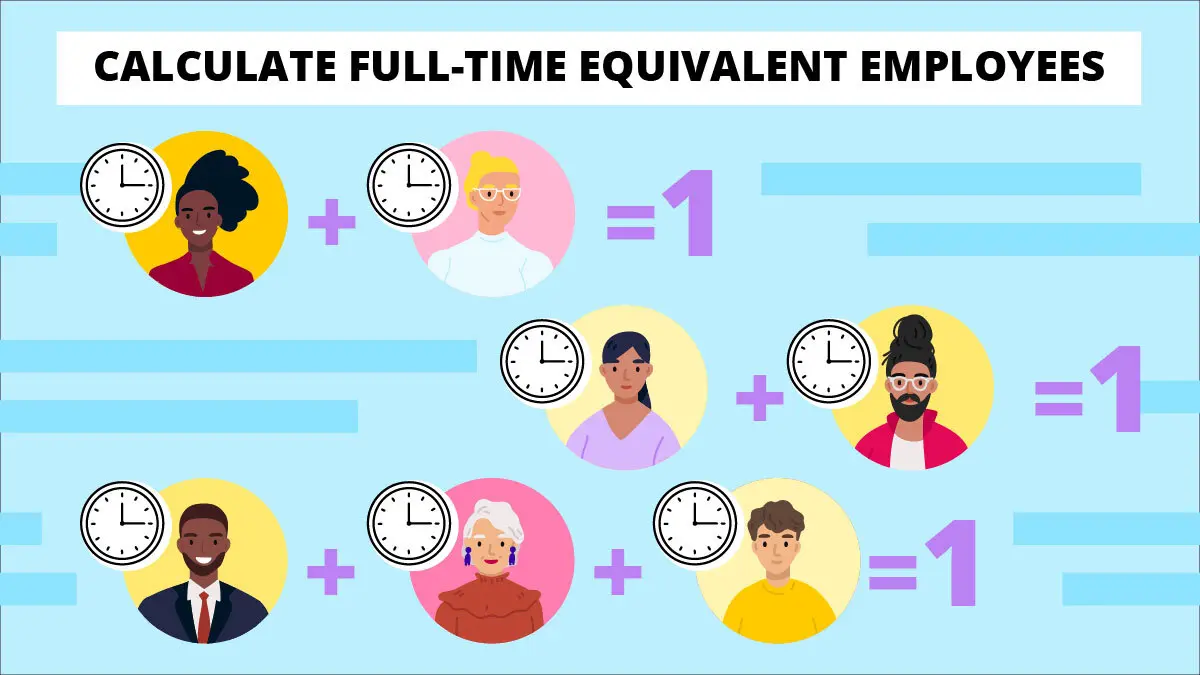
A full-time equivalent employee is a combination of your part-time employees. Each part-time employee counts as a portion of a full-time employee. When you add together multiple part-time employees, you can create full-time equivalent employees.
As an employer, you must follow certain employment laws. Not all laws apply to your business. The laws that pertain to your company depend on how many employees you have. Sometimes, the number of employees (also referred to as a threshold) is determined by the number of FTEs in your company.
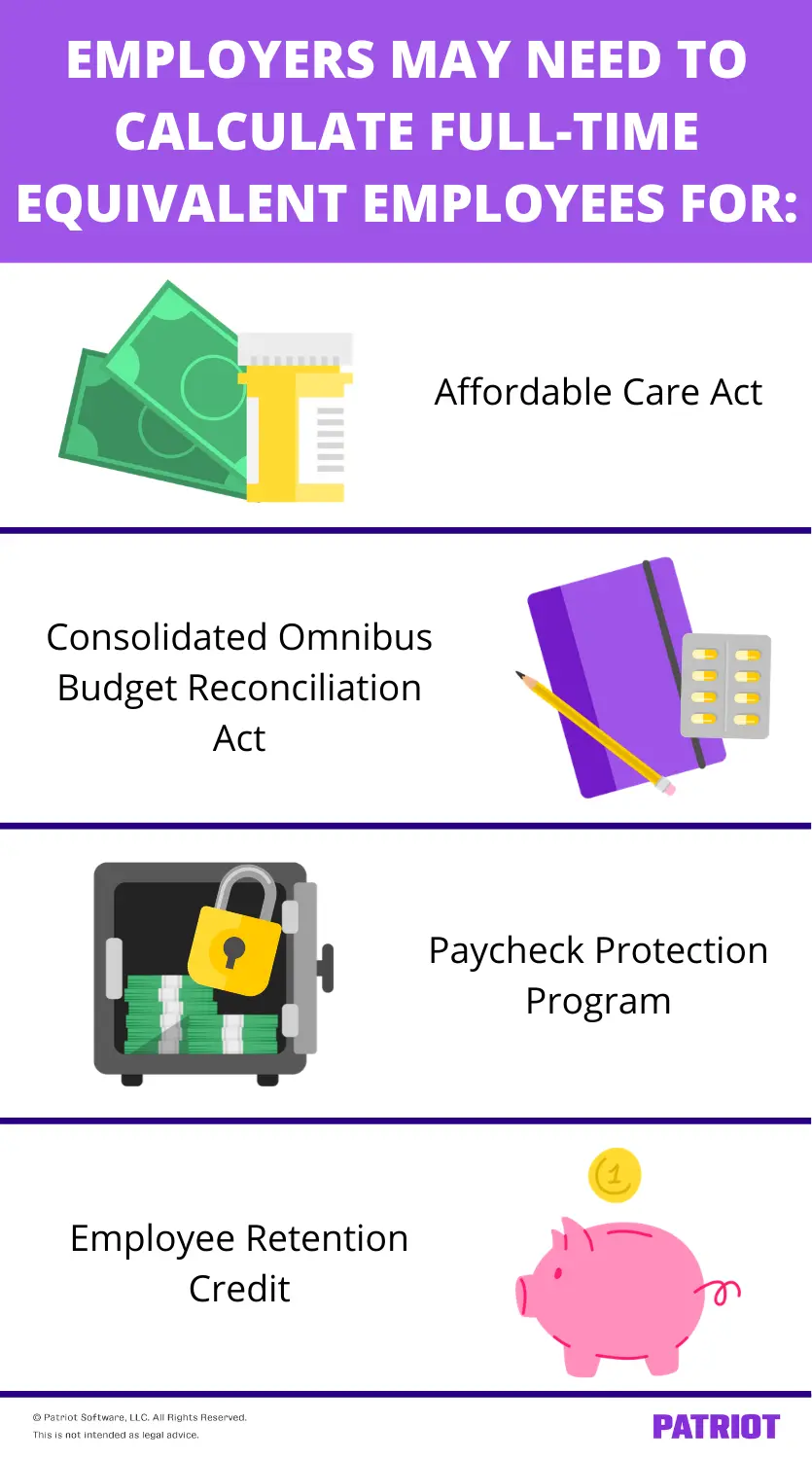
You need to know how many full-time equivalents your business has to determine which employment laws you need to follow. In addition to employment laws, you may need to calculate FTE employees for business loans and other programs (e.g., coronavirus-related programs). Take a look at some laws and programs you may need to calculate FTEs for:
- Affordable Care Act (ACA)
- Consolidated Omnibus Budget Reconciliation Act (COBRA)
- Paycheck Protection Program (PPP)
- Employee Retention Credit (ERC)
ACA
The ACA’s mission is to reduce the cost of health insurance coverage for eligible individuals. The act includes cost-sharing reductions and tax credits to help lower costs for lower-income families and individuals. It requires small group health plans to meet certain requirements, such as covering essential health benefits (e.g., preventative services).
Under the ACA, some employers may be subject to the IRS’s employer shared responsibility provisions. The provisions state that applicable large employers (ALEs) must do one of the following:
- Offer minimum essential coverage that is “affordable” and provides “minimum value” to full-time employees and employees’ dependents
- Potentially make an employer shared responsibility payment to the IRS
You are subject to employer shared responsibility if you have at least 50 FTEs on average during the previous calendar year. Affordable Care Act rules state full-time employees are employees who work at least 30 hours per week or 130 hours per calendar month.
COBRA
COBRA is another act that is based on full-time equivalents. COBRA allows employees, covered spouses, and dependents to temporarily continue their group health insurance coverage if they become ineligible for the plan provided by your business. The act specifies when someone qualifies for COBRA coverage, how long coverage lasts, and when and how employers must provide coverage.
Employers must provide COBRA continuation coverage to employees if they meet both of the following criteria:
- Offer a private-sector group health plan to employees
- Employ at least 20 full-time equivalent employees on more than 50% of your typical business days in the past calendar year
PPP
The Coronavirus Aid, Relief, and Economic Security Act (CARES Act) established the Paycheck Protection Program. The program provides forgivable loans to small businesses to help cover up to 24 weeks of payroll costs, interest on mortgages, rent, and utilities.
Business owners can use 60% of the loan for payroll costs and 40% for non-payroll expenses (e.g., interest on mortgages, rent, and utilities). The PPP incentivizes small businesses to retain employees on payroll during the coronavirus pandemic.
If you take out a PPP loan, your lender looks at your FTE employee headcount (as well as what you spent the money on and employee salaries) during the covered period to determine loan forgiveness.
So, how do you calculate full-time equivalents for PPP? There are two methods to calculate your FTE for PPP during the covered period:
- Enter the average number of hours each employee was paid for per week, divide by 40, and round to the nearest tenth (maximum, 1.0)
- Assign a 1.0 for employees who work 40 hours or more per week and 0.5 for employees who work fewer than 40 hours
The SBA (Small Business Administration) reduces PPP loan forgiveness based on your average FTE employee reduction (mentioned later).
ERC
The Employee Retention Credit is another CARES Act relief measure for businesses. The ERC is a fully refundable tax credit that eligible employers who keep employees on payroll can claim. The credit is equal to 50% of qualified wages eligible employers pay employees between March 13, 2020 and December 31, 2020.
Qualifying wages are the wages and compensations employers pay to employees during the covered time period. This includes qualified health plan expenses associated with said wages. Another factor that impacts qualified wages is the number of FTEs your business had in 2019.
For employers who averaged fewer than 100 FTEs in 2019, the ERC is based on wages paid to all employees. If your business averaged more than 100 FTEs, your tax credit is based on wages paid to employees who did not work during the period.
How to calculate a full-time equivalent employee
FTEs are calculated differently for each law or program. Calculating full-time equivalent employees depends on what you are computing the FTEs for.
How to calculate a full-time equivalent employee:
- Define what you’re calculating FTEs for
Identify the law/program/reporting requirement (because the method and “full-time hours” definition may vary).
- Choose the time period you’re measuring
Pick the period you’ll use for the calculation (e.g., weekly, biweekly, monthly, quarterly).
- Gather your employee counts and hours for the period
Count your full-time employees for the period.
For part-time staff, collect:
– Number of part-time employees, and
– Total part-time hours worked during the period (often you’ll use an average, depending on the requirement). - Convert part-time hours into FTEs
Divide total part-time hours by the full-time hours for the same period:
Part-time FTEs = (Total part-time hours worked in the period) / (Full-time hours for the period) - Add full-time employees to the part-time FTEs
Add the number of full-time employees during the period to the part-time FTEs from Step #4.
Total FTEs = Part-time FTEs + Number of full-time employees
Generally, you can use the following formula to calculate FTEs for your business:
[(# of Part-time Employees X Total # of Part-time Hours Worked Per Period) / (Full-time Hours for the Period)] + # of Full-time Employees = FTEs
Let’s take a look at how calculating FTE can vary. Check out the examples below on how to calculate full-time equivalent employees.
Example: ACA
Let’s check out an example of calculating FTEs for the Affordable Care Act. As a reminder, you are subject to the employer shared responsibility of the ACA if you have at least 50 FTEs on average during the previous calendar year. And, ACA rules state full-time employees work at least 30 hours per week or 130 hours per calendar month.
Say you have 40 full-time employees. You also have 20 part-time employees who each work roughly 60 hours per month.
To find out how many full-time equivalent employees you have, multiply the number of part-time employees you have (20 employees) by the number of hours they work per month (60 hours).
20 part-time employees X 60 hours = 1,200 hours
Next, divide the total hours worked by part-time employees (1,200 hours) by 120 hours (30 hours for full time X 4 weeks) to find how many full-time employees your part-time workers make up.
1,200 hours / 120 hours = 10 employees
Add together your full-time (40) and FTE part-time employees (10) to get your total full-time equivalent employees.
40 full-time employees + 10 FTE part-time employees = 50 FTEs
You have 50 full-time equivalent employees for the month. To find out if you have an average of 50 full-time equivalents for the calendar year, simply add together your total FTEs per month and divide your total by 12.
Example: COBRA
Let’s take a look at calculating FTEs for COBRA. Say employees must work 40 hours per week to be considered full time. You have 20 full-time employees and 16 part-time employees who work about 25 hours per week.
Multiply the number of part-time workers (16 employees) you have by the average number of hours they work per week (25 hours).
16 employees X 25 hours per week = 400 hours
Divide the total part-time employees’ hours (400) by the total hours an employee must work to be full time (40 per week).
400 hours / 40 hours = 10 employees
Your part-time employees make up 10 full-time employees. Add together your full-time employees (20) and your FTE part-time employees (10) to get your full-time equivalent employees.
Your business’s number of FTEs is 30 employees (10 + 20).
To find your full-time equivalents for the calendar year, add together your total FTEs per week and divide your total by 52 (weeks in a year).
If you employ at least 20 FTE employees on more than 50% of your typical business days in the past calendar year and offer a private-sector group health plan to employees, you must offer COBRA continuation coverage.
Looking for a way to streamline your payroll process? With an easy three-step process, Patriot’s payroll software makes running payroll a breeze. And, we offer free, USA-based support. Start your free trial today!
This article has been updated from its original publication date of May 26, 2017.
This is not intended as legal advice; for more information, please click here.