
Owning a small business isn’t for the faint of heart. More than half (53.5%) of U.S. small business owners lose sleep over their business at least a few times a week. Nearly a third of new owners say it happens almost every night.
These numbers come from a new Patriot Software survey of 1,000 small business owners and managers that explores the mental health, financial stress, and personal sacrifices small business owners (SBOs) make every day to pursue the American Dream.
The American Dream remains a strong aspiration. In a May 2026 message marking National Small Business Week, the White House called America’s 36 million small businesses, which employ more than 45% of the workforce, the foundation of national prosperity and the engine of the American Dream. Americans started over 5.5 million new businesses in 2025, according to the U.S. Census Bureau.
In short, entrepreneurship is thriving. But what about the people doing the actual work? Only 22.5% describe their mental health as thriving. The rest are surviving and struggling.
This article examines the grit many SBOs have to have to keep the lights on, their biggest struggles, and whether owning a small business is worth it.
- 53.5% of small business owners lose sleep over their business at least a few times a week; among new owners, 29.6% say it’s almost every night.
- 47.7% have skipped or delayed their own paycheck to keep the business running; 18.2% have done it multiple times.
- 47.2% say financial pressure has gotten worse over the past 12 months.
- 29.4% name affordable healthcare as the single biggest fix that would reduce their burnout, the top answer by a wide margin.
- 84.4% have personally sacrificed their health, relationships, or mental wellbeing for the business.
- 58% feel the broader system (government, financial institutions, the economy) is mostly or completely stacked against them.
- Only 30.8% say they love entrepreneurship and can’t imagine doing anything else; 42.2% are exhausted but staying anyway.
53.5% of small business owners are losing sleep

The image of a small business owner burning the midnight oil isn’t a cliché. For most SBOs, it’s a Tuesday.
Over half (53.5%) of small business owners lose sleep over their business at least a few times a week. The breakdown by tenure is even worse:
- 29.6% of new owners (under 1 year) lose sleep almost every night
- 12.7% of veterans (5+ years) lose sleep almost every night
Among new owners (those in business less than a year), 29.6% say sleeplessness happens almost every single night. Among veterans with five-plus years in, that drops to 12.7%.
The sleepless nights highlights a much bigger issue: chronic stress. This chronic stress most small business owners carry can lead to poor decision-making, declining health, rapid burnout.
For 47.7% of SBOs, their paycheck is the first to go

When cash gets tight, the textbook answer is to cut costs, renegotiate terms, and find inefficiencies. The real-world answer is simpler and more brutal: the owner stops paying themselves.
According to the survey, 47.7% of small business owners have skipped or delayed their own paycheck to keep the doors open. Roughly 18% have done it more than once. Among new owners, the figure climbs to 58.8%.
There’s a striking gender split buried in the data. More male business owners skip paychecks than female business owners:
- 37% of women say they’ve never had to skip a paycheck
- 24.3% of men say they’ve never had to skip a paycheck
When cash is tight, the owner’s paycheck is the most flexible line item on the profit and loss statement to cut. If you’ve ever had to forego a paycheck to keep the lights on or make sure you don’t pay employees late, you know how necessary (but difficult) the decision is.
Financial pressures have worsened for many owners

Nearly half (47.2%) of owners say financial pressure has gotten worse in the past 12 months, with 15.1% describing it as significantly worse and 32.1% as somewhat worse.
The pressure isn’t distributed evenly:
- 25.1% of women business owners name rising costs and inflation as their top stressor
- 30.7% of Baby Boomers name rising costs and inflation as their top stressor
The impact of rising costs and inflation on small businesses is a big deal for the greater economy. The small business sector employs more than 45% of the U.S. private workforce.
Affordable healthcare would reduce burnout among SBOs

More affordable healthcare is the top policy ask among small business owners, and it’s consistent across age, gender, political affiliation, and income. 29.4% name affordable healthcare options designed for small businesses as the single most meaningful fix for burnout, outranking tax simplification, better access to financing, and protection from corporate competition.
The number rises to 44.4% among pregnant business owners. And in a study where men and women differ on almost everything else, healthcare lands at virtually identical numbers across genders, a level of agreement that almost never shows up in survey data this granular.
The connection to the broader story is direct. 24.6% of owners have delayed or gone without health insurance because of business costs. Among new owners, that’s 37.7%. Among Millennials, 32.1%.
The reason healthcare lands at the top isn’t a mystery. Small business owners are too small for group rates, too self-employed for employer coverage, and too squeezed by individual-market premiums to treat health insurance as a given.
When you’re already skipping paychecks, $900 a month for a health insurance premium is out of the question.
Young small business owners are having the hardest time
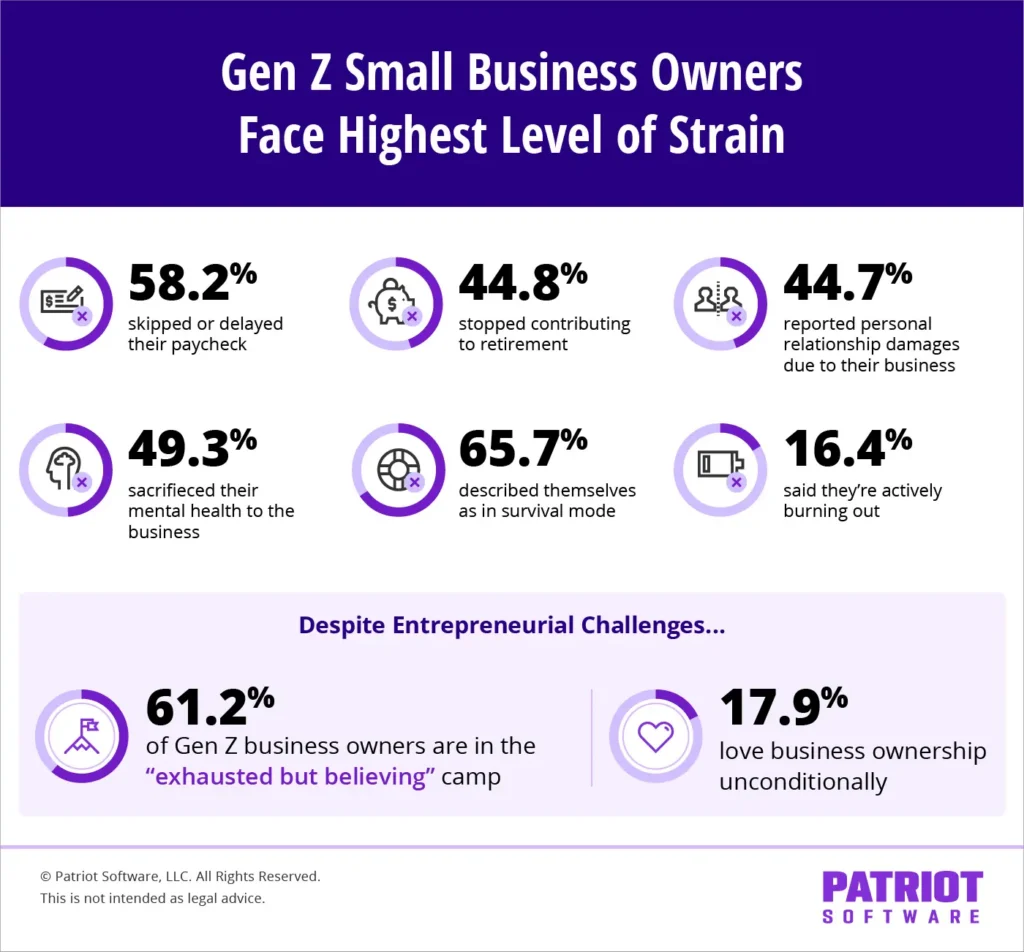
Gen Z SBOs (those aged 18 – 29) report the highest level of strain in the survey, often by significant margins.
58.2% of Gen Z owners have skipped or delayed their own paycheck to keep the business running, on par with new owners as a category. 44.8% have stopped contributing to retirement, the highest of any generation. And 44.7% report real tension or lasting damage to a close personal relationship because of the business.
The mental health numbers are the starkest. 49.3% of Gen Z owners say they’ve sacrificed their mental health to the business, the highest figure of any age group in that specific category. 65.7% describe themselves as in survival mode, and 16.4% say they’re actively burning out, also the highest of any generation. Still, none in the Gen Z cohort describe themselves as having reached a breaking point.
The most telling data point may be how Gen Z owners describe their relationship to the work itself. Despite the challenges of entrepreneurship, 61.2% of Gen Z owners say they are “exhausted but believing,” and 17.9% say they love it unconditionally.
Small business owners sacrifice a lot to keep their dream alive

Only 15.4% of small business owners report no significant personal sacrifices. The remaining 84.4% have given up something:
- Family time (45.8%)
- Physical health (42.2%)
- Mental health (40.9%)
- Hobbies (41.4%)
- Friendships (35.1%)
Not to mention, 28.7% of all owners say the business has caused real tensions or lasting damage to a close personal relationship. Among new owners, that figure jumps to 45.8%, nearly half reporting relational damage within their first year of operation.
Experienced SBOs feel the most unsupported
The owners with the most experience are the ones who recognize the lack of support.
58% of small business owners feel the system is mostly or completely stacked against them. The highest concentration of “completely unsupported” responses, 27.6%, comes from veteran owners with five or more years in business.
Between rising costs and increased tax regulations, owning a small business has become harder than ever.
Despite its challenges, small business owners love entrepreneurship

Owning a small business comes with sleepless nights, financial struggles, and hefty sacrifices. Despite the challenges, an overwhelming 73% still believe in it.
Of that 73%, 30.8% say they love it and can’t imagine doing anything else, and 42.2% say they believe in it but are exhausted.
The remaining quarter are either staying because they’ve already invested too much to walk away or are actively looking for their exit.
Summary
The story small business owners are sharing doesn’t match the national narrative that pushes independence, ownership, and freedom.
In reality, owning a small business is one of the most difficult, yet rewarding, things a person can do. The data highlights the prevalence of sleeplessness, unpaid labor, vanishing healthcare, and a slow accumulation of personal costs.
What’s notable isn’t that small business owners are struggling. It’s how unified they are about what would actually help. Healthcare access. Financial breathing room. A system that recognizes the work. None of it is radical, but it is seriously lacking.
Despite the challenges SBOs endure, new businesses form every day, resulting in millions of startups per year. Entrepreneurs believe in the work they do for their communities and the greater economy. Why not support them along the way?
Methodology
To understand how Americans approach the realities of running a small business, we surveyed 1,000 U.S. adults who are current small business owners, managers, or recent former owners. Participants answered a series of questions about their financial pressure, mental health, personal sacrifices, healthcare access, and overall outlook on entrepreneurship. Responses were analyzed by demographic groups, including work situation (new owners under one year, established owners 1–5 years, veteran owners 5+ years, and former owners or managers), age, gender, household income, parental status, and ethnicity, to identify trends and disparities. The survey was conducted via Pollfish.
Fair use policy
Users are welcome to utilize the insights and findings from this study for noncommercial purposes, such as academic research, educational presentations, and personal reference. When referencing or citing this article, please ensure proper attribution to maintain the integrity of the research. Direct linking to this article is permissible, and access to the original source of information is encouraged.
For commercial use or publication purposes, including but not limited to media outlets, websites, and promotional materials, please contact the authors for permission and licensing details. We appreciate your respect for intellectual property rights and adherence to ethical citation practices. Thank you for your interest in our research.
This is not intended as legal advice; for more information, please click here.