Tipped income is already complicated. And it got even more complex with the passage of the One Big Beautiful Bill Act (OBBBA) in 2025, which brought major tax changes. One of the biggest? Certain tipped employees will no longer pay federal income tax on their tips.
Tucked inside the massive One Big Beautiful Bill Act (signed on July 4, 2025), the new “no tax on overtime,” rule gives many hourly workers a reason to pay closer attention to their pay stubs. Retroactive to January 2025, eligible employees can deduct a chunk of their overtime earnings from their federal taxable income. The idea is simple: work more, keep more.
Overtime pay, or time and a half, is currently taxed like regular wages. The “no tax on overtime” rule provides a federal income tax deduction equal to overtime wages reported in a year.
Sure, you’re not likely to hear employees complain about paying less in taxes. But what does this new tax law actually mean for how you handle overtime in payroll? Let’s break down the “no tax on overtime” rule and how it impacts your employees on payroll.
Under federal law, overtime is 1.5 times an employee’s regular hourly wage for each hour worked over 40 in a workweek. Nonexempt employees are entitled to overtime pay under the Fair Labor Standards Act. Only 12% of employees work FLSA-qualified overtime regularly, and an additional 5% work FLSA overtime occasionally.
When employees receive overtime wages, you calculate and withhold taxes the same way as you do for regular wages. You must remit all withheld taxes to the proper agencies and report income and taxes on Form 941 and each employee’s W-2 form.
The new overtime taxation law exempts employees’ overtime wages from federal income tax.
What is the new “no tax on overtime” law?
Like another popular provision, “no tax on tips,” the “no tax on overtime” is a key component of the One Big Beautiful Bill Act (OBBBA).
This legislation allows a federal income tax deduction specifically for overtime pay, aiming to provide financial relief to eligible workers through tax deductions on overtime wages.
How does the “no tax on overtime” law work?
Nonexempt employees who work time-and-a-half hours (i.e., hours beyond 40 in a workweek) can now claim a federal income tax deduction equal to the qualified overtime compensation they receive during the taxable year when filing their income taxes. The tax deduction for overtime wages is available for tax years 2025 through 2028.
The “no tax on overtime” only applies to nonexempt employees who work FLSA-qualified overtime. The tax deduction would not be available to highly compensated employees. Employees can only claim a tax deduction on overtime federal income taxes if they make up to $160,000 and have a Social Security number.
It’s important to point out, the tax deduction is only for the “premium wages” paid on overtime (the “extra half” of time-and-a-half pay) if the employee meets the IRS requirements.
And, the “no tax on overtime” only applies to federal income tax. Still, several states are also considering a no tax on tips and overtime law as well.
Do employers still withhold taxes on overtime?
Yes. If your employees work more than 40 hours in a week, you still need to track and tax the overtime wages like any other wages. You must continue withholding federal income tax, Social Security, and Medicare as well as any state or local taxes from overtime wages just as you would with regular wages. Overtime pay remains fully taxable.
What’s changed is that employees may now be eligible to deduct up to $12,500 for individuals and $25,000 for joint filers of their gross overtime wages when they file their federal tax return. This deduction could reduce their taxable income, potentially lowering what they owe or increasing their refund.
Be prepared for employees who may adjust their W-4 form to lower their tax withholding. The IRS updated the new 2026 Form W-4 Deductions Worksheet for step 4(b) to include fields for estimated tip income, the “and-a-half” portion of overtime, as well as other new fields. Either way, when an employee adjusts their federal income tax withholding, you must update your payroll.
Guidance for tracking overtime on 2025 employee W-2s
On August 7, 2025, the IRS confirmed* that for Tax Year 2025, Form W-2, Forms 1099, and 941, and the federal income tax withholding tables will remain unchanged during the phased rollout of the One Big Beautiful Bill Act. Updated guidance and new forms are planned for 2026.
While payroll reporting won’t change, accurate overtime tracking will be critical for employees who want to claim the federal overtime tax deduction on their 2025 returns. Even though overtime won’t appear separately on the W-2 this year, employees can still deduct the FLSA overtime premium if they meet the IRS requirements.
So where would you come in? This doesn’t change your payroll process, but it does mean your overtime tracking needs to be accurate. Employers should be aware that tracking may get more complex, especially in states or localities with stricter overtime rules than the FLSA. Those additional amounts will not qualify for the federal deduction.
Make sure FLSA overtime hours and premium pay are recorded clearly and accessible to employees. Using time and attendance software can help maintain accurate, digital records and make year-end reporting easier for everyone.
*The IRS has stated it will provide transition relief for tax year 2025 for taxpayers claiming the deduction and for employers and other payors subject to the new reporting requirements. Because of this, the IRS has provided general guidelines on how to determine the overtime tax deduction amount.
Employees who received overtime compensation in 2025 can use the overtime amounts shown on pay stubs, earning statements or similar documents to figure the FLSA overtime premium wages for the year.
One simple estimate example provided by the IRS was to use a pay statement that shows all the wages earned in 2025 and use the overtime total listed there. For example:
The employee’s end of year totals on a pay statement shows a total of $15,000 in “overtime” pay. That $15,000 includes both:
The extra FLSA overtime premium, and
The regular pay for the hours worked over 40 in a week.
For figuring out how much qualified overtime compensation they got in 2025, the employee can count $5,000 of that amount. That $5,000 is the FLSA overtime premium, which they get by taking the $15,000 total overtime and dividing it by 3.
Whatever is used, employees should be sure to keep copies of those pay stubs and records, since the IRS requires taxpayers to keep the documents relied on for your tax calculations.
Proposed 2026 Form W-2 overtime reporting changes
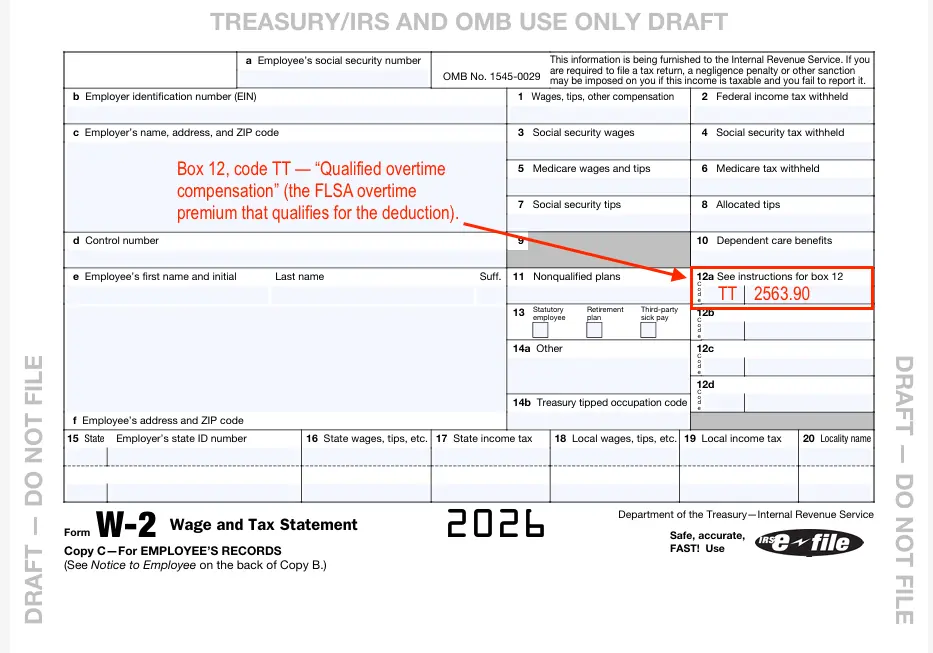
The IRS has released a the 2026 Form W-2 introducing code TT for Box 12 for employers to report FLSA qualified overtime compensation, the half-time premium that employees may exclude from taxable income.
Qualified overtime premium reporting proposed for 2026 Form W-2
“No tax overtime” FAQs
Are you taxed on overtime?
Yes, overtime hours are subject to taxation like regular wages. Employers will withhold as they normally will in payroll. Employees who qualify may be able to claim a tax deduction on overtime wages when filing their income taxes.
Is overtime pay now completely tax-free?
Not quite. The One Big Beautiful Act introduced a new tax break that lets employees deduct part of their overtime pay, up to $12,500 for individuals and $25,000 for joint filers, on their federal income tax return. But this doesn’t change how payroll is run. All regular payroll taxes still apply to overtime, and paychecks will look the same throughout the year. The deduction only kicks in when employees file their taxes at year-end.
What is the point of a tax deduction for overtime?
The goal of the tax break for nonexempt employees who work overtime is to let them keep more of their wages.
How should employers handle overtime on W-2s?
For the 2026 tax year, employee W-2s will need to reflect FLSA overtime with code TT for Box 12 for employers to report FLSA qualified overtime compensation, the half-time premium that employees may exclude from taxable income.
When does the no tax on overtime change take effect?
The provision is retroactively effective from January 1, 2025, and will remain in place through the end of 2028. This means overtime earnings from the beginning of 2025 are eligible for the deduction.
How will no tax on overtime affect employee paychecks?
Employees won’t see immediate changes in their take-home pay on paychecks (unless they adjust their Form W-4 withholding). The benefit is realized when filing federal tax returns; an employee’s taxable income will be reduced by the amount of qualifying overtime, potentially resulting in a larger refund or lower tax liability.
Does “no tax on overtime” affect employee Social Security benefits?
No. Even though federal income tax is not applied to qualifying overtime, Social Security and Medicare taxes still are. Therefore, your social security tax contributions, (and future benefits) remain unaffected.
Does no tax on overtime include state taxes?
The “no tax on overtime” provision only applies to deductions on federal income taxes. It does not include state (or local) tax deductions. Although Alabama had an exception for overtime hours, it expired in June 2025. Other states are considering some type of overtime or tips laws in the future, but would need to be passed at the state level.
Do employers need to give employees a special report for overtime wages in 2025?
The IRS isn’t requiring overtime reporting other than what is standard on pay reports. Employers should use a “reasonable approximation” method to calculate overtime for the 2025 transition tax. See the IRS notice for more information.
This article has been updated from its original publication date of May 15, 2025.
This is not intended as legal advice; for more information, please click here.
Payroll delays are serious. In many states, you must pay employees on time by law.
Be transparent and fast. Tell employees what happened, what you’re doing, and when they’ll be paid.
Own the mistake. Avoid blame, legal jargon, or vague promises.
Follow up in writing. Use clear, simple language and share a firm expected payment date if you can.
Fix the root cause. Tighten your payroll process so you’re not asking “Can I pay employees late?” again.
Payroll is how your employees get paid. When it’s delayed, your team might not be able to pay for their rent, groceries, childcare, or bills. Even one late paycheck can damage trust.
You might be asking yourself, “Can I pay employees late?” From a legal standpoint, many states have strict payday rules. From a leadership standpoint, late pay is a major trust test.
You can’t always avoid every crisis that causes payroll delays. But you can control how you communicate and how quickly you make things right.
In this guide, we’ll walk through:
What to do the moment you realize payroll will be late
How to talk to employees
Legal and compliance considerations to keep in mind
How to prevent delayed payroll in the future
Step 1: Confirm the situation and impact
Before you say anything to employees, get clarity.
1. Identify the cause.
Cash flow shortfall?
Bank or processor issue?
Payroll processing error?
Missed deadline?
2. Estimate the delay.
Will pay be late by hours, a day, or more?
Is this affecting everyone or just certain employees (e.g., direct deposit vs. paper checks)?
You don’t need every detail to start communicating, but you do need a realistic sense of who is affected and how long the delay might last.
Step 2: Communicate early (even if you don’t have all the answers)
Silence is the fastest way to lose trust. As soon as you know pay will be late, give your employees a high-level overview of what happened, let them know you’re working on it, and give an estimate of when you expect to resolve the situation or give another update.
Keep your message:
Honest: Don’t sugarcoat or mislead.
Clear: Avoid jargon and complicated explanations.
Empathetic: Acknowledge the stress this may cause.
Action-oriented: Explain what you’re doing to fix it.
Here’s a simple sample message for notifying your team:
Subject: Important update about today’s payroll
I wanted to let you know as quickly as possible that today’s payroll has been delayed due to [brief reason, e.g., “a banking issue we’re working to resolve”].
We understand that you count on getting paid on time, and we know this delay can cause real stress and inconvenience. We’re treating this as our top priority.
We expect to have this resolved by [estimated date/time]. We will send another update by [specific time] with more details, even if the situation has not fully cleared.
If this delay creates an urgent hardship for you, please reach out to [name/HR contact] so we can talk through options.
We’re very sorry this is happening and appreciate your patience while we work to make this right.
If you truly don’t know the exact timing yet, give a specific time for the next update, not a vague “soon.”
Step 3: Address employee concerns individually and with empathy
After your initial announcement, expect questions. Some team members may be calm. Others may be worried or angry.
When speaking individually:
Listen first. Let them explain how this affects them.
Acknowledge the impact. “I understand this puts you in a tough spot.”
Avoid defensiveness. Don’t blame employees, banks, or “the economy” in a way that dodges responsibility.
Share concrete next steps. Repeat what you’re doing and when they can expect updates.
Here’s a simple sample message for a one-on-one conversation:
“You’re right to be frustrated. You work hard, and you should be paid on time. We had [very short explanation], and we’re doing [specific actions] to get this resolved by [timeframe].
I know that doesn’t fix the immediate stress, but I want you to hear directly from me that paying you is our top priority. We’ll update everyone by [time] today, and if this creates an urgent hardship, please let me know so we can see what we can do.”
Step 4: Provide a clear, written follow-up with details
Once you have firm information, send a second, more detailed update.
Include:
Exact pay date/time (or as precise as possible)
How pay will be issued (direct deposit, paper checks, special run)
Any fees you will cover (e.g., bank overdraft fees)
What you’re changing to prevent this in the future
Here’s a simple sample follow-up message:
Subject: Update on payroll timing and next steps
Thank you for your patience while we worked through the payroll delay.
All employees will receive their full pay for the [pay period dates] on [date] by [time]. Payments will be made via [direct deposit/paper check/other].
We know this delay may have caused financial stress. We are [e.g., “reimbursing documented overdraft fees related to this delay,” or other support you decide to offer]. Please contact [contact person] if you need help with this.
To prevent this from happening again, we are [brief explanation of process changes, e.g., “moving to an earlier payroll processing cutoff and adding a backup funding check”].
We appreciate your dedication and the trust you place in us. We are committed to earning that trust every pay period.
Step 5: Understand the legal side of late payroll
From a compliance standpoint, late paychecks can create legal risk. Many states have:
Rules about deductions and what you can and can’t withhold
Avoid paying your team late whenever possible. You may face penalties or claims if you miss required paydays. Move quickly to correct issues and prevent repeat issues.
For detailed guidance on what happens when you can’t make payroll, consider talking with an employment attorney or tax professional.
Step 6: Fix the root cause so it doesn’t happen again
Once the crisis is past, take a hard look at what went wrong. Your employees will judge you not just by the mistake, but by what you do next.
Using tools that are slow, complex, or easy to misconfigure
Take a look at the following tips to help you avoid delaying payroll again:
Standardize deadlines. Set internal cutoffs for timesheets and approvals earlier than your provider’s deadlines.
Improve cash flow visibility. Use simple forecasting and keep a buffer in your payroll account.
Automate calculations. Use payroll software that calculates wages and taxes for you and helps streamline payroll tax work.
Create a backup plan. Decide ahead of time what you’ll do if your main funding source has an issue (e.g., backup account, emergency line of credit).
A reliable payroll system doesn’t just help you pay people correctly. It helps you pay them on time, every time.
Simple checklist: Communicating a payroll delay
Action
Done?
Confirm who is affected and for how long
☐
Check pay schedule and state requirements
☐
Send initial notice as soon as possible
☐
Offer a clear time for the next update
☐
Address individual concerns with empathy
☐
Send a detailed follow-up with exact timing
☐
Document what happened and why
☐
Fix your process to prevent repeat issues
☐
Frequently asked questions
Can I pay employees late?
Many states legally require you to pay employees on a regular, predictable schedule. Paying late can lead to penalties, wage claims, or interest. Even if your state doesn’t spell out every scenario, late pay can still create legal and trust issues.
If you’re facing a situation where you can’t make payroll, move quickly to correct it, communicate clearly with your team, and talk with a legal or tax professional about your obligations.
What should I say to employees if payroll is delayed?
Be direct and honest. Explain that payroll is delayed and give a brief, factual reason why. Share what you’re doing to fix it. Provide a realistic timeframe or a clear time for the next update. Acknowledge the stress this may cause and apologize.
Avoid vague promises, blaming others, or minimizing the impact.
Should I communicate a payroll delay in writing or in person?
Ideally, you should do both. Consider drafting a written message to your entire team, setting up an in-person or video meeting, and scheduling one-on-one conversations for those especially concerned.
What if I don’t know exactly when payroll will be fixed?
Say that clearly, and give a specific time for the next update:
“We don’t have a confirmed time yet, but we will update everyone by 3:00 p.m. today.”
Even “no new information” is better than silence.
How can I prevent payroll from being late in the future?
You can reduce the risk by:
– Setting earlier internal deadlines for timesheets and approvals – Improving cash flow forecasting and maintaining a payroll buffer – Using payroll software that automates calculations and helps streamline payroll tax tasks – Building a simple backup plan for banking or funding issues – Reviewing your process after any incident and tightening weak spots
Patriot’s payroll is built to help you run payroll quickly and accurately, reduce the risk of missed deadlines, and skip manual calculations. Try it free today!
This is not intended as legal advice; for more information, please click here.
As a small business owner, your doors likely aren’t open 24/7. And if you’re like most businesses, you might be closed on federal legal holidays like Thanksgiving or Christmas.
According to the Bureau of Labor Statistics, the average full-time employee receives approximately 7.6 paid holidays annually.
Stick to the same payroll processing dayeach period (e.g., every other Monday).
Use a calendar with reminders a few days before payroll is due.
Automate what you can
Manual payroll is slow and error-prone. Automation can help you:
Calculate gross pay, taxes, and deductions accurately
Track hours, overtime, and paid time off
Generate pay stubs and reports
Keep a consistent schedule, even when you’re busy
Simple checklist: Are you at risk of paying employees late?
Use this quick checklist to spot risk areas:
Question
Yes
No
Do you rely on manual spreadsheets for payroll?
Have you missed or nearly missed a payday before?
Is your cash flow tight around payday?
Do you lack a backup person to run payroll?
Do you feel unsure about your state’s payday rules?
If you have several “Yes” answers, it may be time to tighten your process and consider a more reliable payroll system.
Frequently asked questions
Can I pay employees late if cash is tight?
Cash flow problems don’t excuse late payment of wages. You’re still required to pay employees in full, on time, according to federal and state laws. If you’re in a crunch, communicate with employees and seek professional guidance, but prioritize catching up on wages.
Can employees agree to be paid late?
Verbal agreements to late pay don’t override wage laws. You can still face penalties or claims from the employee or a state agency.
What if my bank deposit failed or there was a payroll error?
Fix it as quickly as possible. Notify affected employees, correct the issue, and document what happened. One genuine error, promptly corrected, is typically treated differently than a pattern of late payments (but repeated “errors” can still lead to penalties).
What happens if I repeatedly pay employees late?
You may face wage claims, penalties, interest, and legal fees. Employees may also quit, leave negative reviews, or report you to state agencies. Repeated late payroll can become very expensive and damage your business’s reputation.
Can I change my payday schedule?
Usually, yes, but you must follow state rules and give employees advance notice. You also must ensure there’s no gap where employees go unpaid for work already performed. When in doubt, check your state’s requirements on changing payroll frequency.
How can payroll software help prevent late paychecks?
Payroll software can:
– Automate calculations and tax withholding – Help you run payroll quickly from anywhere with internet access – Provide clear records and pay stubs for employees
These features reduce the chance of missed deadlines due to manual errors or time crunches.
Make late payroll a thing of the past
You work hard to build your business. Your employees work hard to keep it running. Paying them accurately and on time is one of the most important promises you make.
If you’re tired of:
Racing the clock on payday
Stressing over manual calculations
Worrying about late checks and compliance
…Patriot Software has your back. Spend less time on paperwork and more time growing with a free trial!
This is not intended as legal advice; for more information, please click here.
States typically treat late paychecks as unpaid wages. That can trigger:
Civil penalties (fines payable to the state)
Additional wages owed to the employee (e.g., extra days of pay)
Interest on unpaid wages
Attorney fees and court costs if the employee sues and wins
Penalties are often stricter for final paychecks when an employee quits or is fired.
State-by-state guide: Late paycheck penalties
Below is a high-level, educational overview of how states handle late or unpaid wages.
If a state does not have a state-specific rule for late or unpaid wages, you must typically rely on FLSA rules. The FLSA requires that you pay employees on their regularly scheduled payday.
Laws change frequently, and penalties can depend on the facts of each case. Always verify with your state labor department or small business lawyer before making decisions.
State
Late Paycheck Consequences
Alabama
No specific rule.
Alaska
Late wages may trigger penalties and interest. Final pay deadlines vary by termination vs. resignation.
Arizona
Late wages can result in employees recovering up to three times the unpaid wages in a civil action.
Arkansas
Late or unpaid wages may lead to civil penalties. If an employer fires someone and doesn’t pay their final paycheck within seven days of their next scheduled payday, the employer owes twice the amount.
California
Late payment penalties apply if employees do not receive full wages on payday. Initial penalty is $100 for each failure, and subsequent violations or intentional violations are $200, plus 25% of the amount of wages unlawfully withheld.
Colorado
Employees can send a written demand for wages. If wages aren’t paid within 14 days of a valid written demand, the employer may owe penalties, which can be $50 per day, plus attorney fees.
Connecticut
Late wages may result in the employer owing twice the full amount, plus attorney fees.
Delaware
Civil penalties for willful nonpayment. Employees can file wage claims and may recover unpaid wages, interest, and costs.
District Of Columbia
Penalties can include additional wages, civil fines, and attorney fees.
Florida
No specific rule.
Georgia
No specific rule.
Hawaii
Late or unpaid wages may result in civil penalties and interest.
Idaho
Employers are responsible for penalties on wages until paid in full or for 15 days, whichever is less. Employees can send a written demand for final wages, which must be paid within 48 hours of receiving the request.
Illinois
Penalties for unpaid and underpaid wages. Employees are entitled to their earned wages plus 5% of the underpayment per month.
Indiana
Employees may be entitled to their earned wages, a penalty rate equal to their daily rate of pay for each day late, and attorney fees.
Iowa
Employers may owe unpaid wages, additional payments, and attorney fees for violations.
Kansas
Civil penalties and potential criminal penalties for willful violations.
Kentucky
Late wages may trigger penalties and attorney fees.
Louisiana
If final wages are not paid within required time, employers may owe up to 90 days of wages or actual damages, whichever is less, plus attorney fees.
Maine
Employers may owe unpaid wages, interest, and up to three times the amount of unpaid wages.
Maryland
Employees may recover up to three times the unpaid wages plus attorney fees for certain violations.
Massachusetts
Employees may recover three times of unpaid wages plus attorney fees for late or unpaid wages, including late final paychecks.
Michigan
Employers may owe unpaid wages, interest, and possible penalties.
Minnesota
Late wages can trigger penalties based on the amount owed and days late. Employees may recover unpaid wages, penalties, and attorney fees.
Mississippi
No specific rule.
Missouri
Late wages may be treated as minimum wage or wage payment violations.
Montana
Employers may owe wages plus penalties based on delay.
Nebraska
Employers may owe unpaid wages, up to 100% of unpaid wages as damages, and attorney fees.
Nevada
Employers may owe wages for each day the paycheck is late, up to a set maximum number of days.
New Hampshire
Employers may owe unpaid wages, liquidated damages, and civil penalties.
New Jersey
Wage theft laws allow liquidated damages up to 200% of unpaid wages, plus fines and potential criminal penalties for repeat offenders.
New Mexico
Employers may owe unpaid wages, plus additional wages and attorney fees.
New York
Employers may owe unpaid wages, liquidated damages up to 100%, interest, and attorney fees.
North Carolina
Employers may owe unpaid wages, interest, and possible penalties.
North Dakota
Employers may owe penalties if they fail to pay wages after demand, including additional wages up to a cap.
Ohio
Late wages may be treated as minimum wage or wage payment violations. Employees may recover unpaid wages, liquidated damages, and attorney fees.
Oklahoma
Employers may owe unpaid wages plus penalties and interest.
Oregon
Employers may owe up to 30 days of the employee’s regular wages if final pay is late, plus penalties for late regular paydays.
Pennsylvania
Employers may owe unpaid wages, liquidated damages (up to 25% of wages or $500), and attorney fees.
Rhode Island
Employers may face civil and criminal penalties for willful nonpayment, plus unpaid wages and possible additional damages.
South Carolina
Employers may owe unpaid wages plus treble damages and attorney fees for willful violations.
South Dakota
Limited specific penalty statutes. Employees may sue for unpaid wages and seek damages.
Tennessee
Employers may face civil penalties and be liable for unpaid wages and costs.
Texas
Employers may owe unpaid wages and interest; repeated violations can bring additional penalties.
Utah
Employers may owe unpaid wages plus penalties and interest; amounts can increase after written demand.
Vermont
Employers may owe unpaid wages, interest, and liquidated damages up to double wages, plus attorney fees.
Virginia
Wage theft laws allow double or treble damages for willful nonpayment, plus attorney fees and civil penalties.
Washington
Employers may owe unpaid wages, interest, and double damages in some cases, plus penalties for repeat violations.
West Virginia
Employers may owe unpaid wages, liquidated damages, and attorney fees; criminal penalties possible for willful violations.
Wisconsin
Employers may owe unpaid wages plus increased damages (often up to 50% of wages) and attorney fees.
Wyoming
Employers may owe unpaid wages, interest, and costs.
How to avoid late paycheck penalties
You have enough on your plate. Here are some tips to prevent wage trouble:
Set a clear payroll schedule: Choose weekly, biweekly, semimonthly, or monthly pay, based on your state rules. Put it in writing and share it with employees.
Know your state’s final pay rules: Deadlines can change depending on whether an employee quits or is fired. Keep a quick-reference document handy for your state(s).
Build a payroll checklist: Include tasks like timecard approvals, overtime review, deductions and benefits, and direct deposit deadlines.
Use payroll software to automate the routine: Set reminders for payroll run dates and payroll cutoffs. Store employee pay rates and hours in one place. Reduce manual math and data entry mistakes.
Keep a cash reserve: Sometimes, you can’t make payroll due to cash flow issues. Create an emergency fund to ensure you can pay your employees on time.
Have a backup plan: Designate a backup payroll admin. Document your payroll process so someone else can run it if you’re out.
Simple table: Late paycheck risk snapshot
Risk
What Can Happen
How to Reduce Risk
Late regular paycheck
Wage claims, interest, penalties
Automate payroll, set calendar alerts, keep cash reserve
Late final paycheck
Waiting time penalties, extra days of wages
Know state final pay deadlines
Repeated late payments
Higher fines, possible lawsuits, reputational harm
Standardize payroll processes, assign backups
Poor documentation
Harder to defend in disputes
Keep records of hours, pay, and policies
Frequently asked questions
Can I pay employees late if cash flow is tight?
Most states require you to pay employees on the regular payday, regardless of your cash flow. If you’re struggling, talk with your bank or advisor about short-term financing.
What happens if I miss payday by a day or two?
Even a short delay can be considered a wage violation. Depending on your state, employees may be able to file a complaint or claim additional penalties. Fix the issue as quickly as possible, know how to communicate delayed payroll to your employees, and document what happened.
Are penalties worse for late final paychecks?
Often, yes. Many states impose penalties or extra wages when final paychecks are late, particularly if the employee was fired. Some calculate penalties per day late, up to a cap. Check your state’s rules before terminating employees.
Do late paycheck rules apply to salaried employees?
Yes. Payday and wage payment laws generally apply to both hourly and salaried employees. Being salaried does not give you extra time to pay.
How can payroll software help me avoid late paychecks?
You can run payroll in minutes with payroll software or automate the process with certain providers.
Spend less time worrying about paydays
You didn’t start your business to memorize wage penalty charts. You want to pay your team fairly, stay compliant, and get back to serving customers.