For business owners in most states, collecting and remitting sales tax is part of the job description. But on select dates throughout the year, your customers can take advantage of a sales tax holiday.
As a business owner, you must know about and adjust your collections process for sales tax holidays.
Read on to learn what is a sales tax holiday, the dates by state, and how you can maximize your revenue during a tax holiday.
Overview of sales tax
Sales tax is a pass-through tax that businesses in most states collect from customers at the point of sale (POS). The tax is a percentage of the customer’s bill tacked on to their purchase total.
Although businesses don’t contribute to sales taxes, they are responsible for remitting sales tax to the proper government agency.
Sales tax laws by state vary. States have different:
- Rates (e.g., 6%)
- Laws on sales tax nexus (i.e., whether you have significant presence in an area to collect sales tax)
- Economic nexus laws (i.e., sales tax nexus for out-of-state sellers)
- Sales tax methods (e.g., destination- vs. origin-based)
Not all states have sales tax. The following states do not have a state-mandated sales tax:
- Alaska
- Delaware
- Montana
- New Hampshire
- Oregon
Hawaii and New Mexico also do not have a sales tax. However, they have similar taxes known as general excise and gross receipts taxes. And New Mexico has a sales tax holiday, exempting customers from the gross receipts tax.
What is a sales tax holiday?
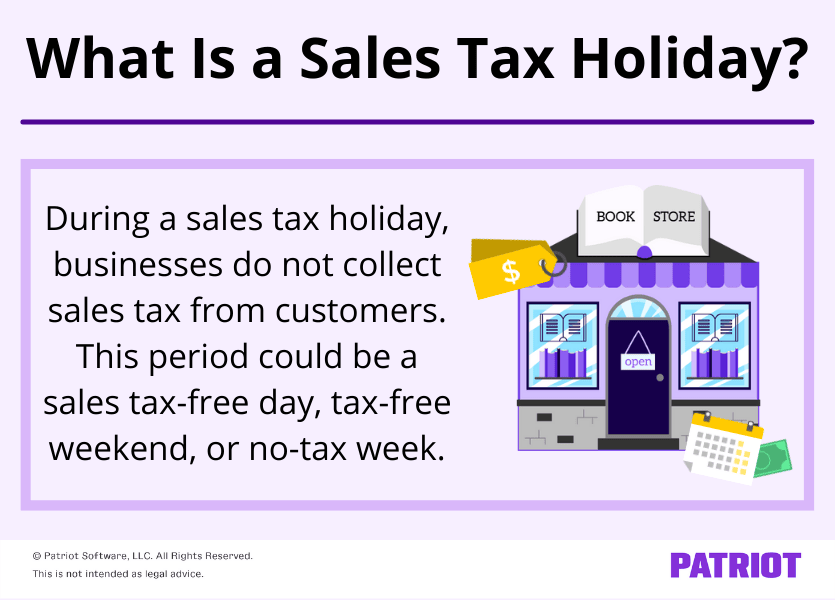
A sales tax holiday is a short-term exemption from state sales tax. During a sales tax holiday, you do not collect sales tax from customers.
This period could be a sales tax-free day, tax-free weekend, or no-tax week. There are also sales tax-free periods that can last for a year or longer.
The length of a sales tax holiday depends on the state you operate in. Keep in mind that not all items are sales-tax exempt during a sales tax holiday.
Not all states have a sales tax holiday. And participating states have different rules for exemptions.
State rules can vary in regards to:
- The sales tax holiday dates
- Time-span of the tax-free holiday (e.g., day vs. week)
- Which items are exempt from sales tax
- The maximum amount of a tax-exempt purchase
- Whether the maximum amount is per item or for the total purchase
If you do business in a state with a sales-tax-free weekend, week, or day, you need to know the rules.
Preparing for a sales tax holiday
Before your business can participate in a no-sales tax day, weekend, week, or period you must prepare. Make sure you know:
- Your state’s sales tax rules
- Your state’s rules for reporting sales tax exemptions in your accounting books
- Items exempt from sales tax during the holiday and maximum limits
- Whether you must charge state or local sales tax on certain items
- Rules about online sales, rainchecks, layaway, and gift certificates
- Whether you need to participate
- When the sales tax holiday officially begins (e.g., 12:01 a.m.)
- Whether certain cities, counties, etc. are exempt from participating in the tax holiday
Keep in mind that not all states have sales tax holidays. And not all states have sales tax to begin with.
2026 Sales tax holidays by state
Need help keeping track of your state’s no-tax weekend, week, or day? Use the chart below to find out which states have a sales tax holiday in 2026 and see examples of exempt items.
Keep in mind that some states (e.g., Texas) may have multiple sales tax holidays throughout the year.
Consult the state sales tax holiday for more information, including a complete list of items included and maximum amounts for exemptions.
| State | Name of Tax Holiday | Dates (2026) | Examples of Items Included | Best official link to use |
|---|---|---|---|---|
| Alabama | Severe Weather Preparedness Sales Tax Holiday | Feb 20–22 | Portable generators + severe weather prep items | Alabama Department of Revenue |
| Alabama | Back-to-School Sales Tax Holiday | July 17–19 | School supplies, clothing, computers, books | Alabama Department of Revenue |
| Arkansas | Sales Tax Holiday | Aug 1–2 | School supplies, clothing, instructional materials, electronics | Arkansas Finance & Administration |
| Connecticut | Sales Tax-Free Week | Not posted yet for 2026 (expected Aug 16–22) | Clothing and footwear | CT.gov |
| Florida | Back-to-School Sales Tax Holiday | Aug 1–31 | Clothing, school supplies, learning aids, computers | Florida Department of Revenue |
| Iowa | Annual Sales Tax Holiday | Aug 7–8 | Clothing and footwear | Department of Revenue |
| Maryland | Shop Maryland Energy Weekend | Feb 14–16 | ENERGY STAR appliances + solar water heaters | PDF (2026): Shop Maryland Energy Weekend |
| Maryland | Shop Maryland Tax-Free Week | Aug 9–15 Each year: during the second week of August | Clothing/footwear under $100; first $40 of backpacks | Maryland Comptroller |
| Massachusetts | Massachusetts Sales Tax Holiday | TBD for 2026 Each year: A Saturday and Sunday occurring concurrently in August | Most retail items (usually up to a per-item cap) | Mass.gov |
| Mississippi | Sales Tax Holiday (Back-to-School) | July 10–12 Each year: 2nd Friday in July | Clothing, footwear, school supplies under $100 | Mississippi Department of Revenue |
| Mississippi | Second Amendment Sales Tax Holiday | TBD (usually late August) | Firearms, ammunition, certain hunting supplies | Mississippi Department of Revenue |
| Missouri | Show Me Green Sales Tax Holiday | Apr 19–25 | ENERGY STAR appliances | Missouri Department of Revenue |
| Missouri | Back-to-School Sales Tax Holiday | Aug 7–9 | Clothing, school supplies, computers, calculators, software | Missouri Department of Revenue |
| New Mexico | Gross Receipts Tax Holiday (Back-to-School) | July 31 – August 2 Each year: On the last Friday in July, through midnight the following Sunday | Clothing/shoes + computers + school supplies (caps vary) | Taxation and Revenue New Mexico |
| Ohio | Annual Sales Tax Holiday | Aug 7–9 Each year: Includes the first Friday, Saturday, and Sunday in August | Clothing, school supplies, other eligible items (state sets at least 3 days) | Ohio.gov |
| Oklahoma | Sales Tax Holiday | August 7–9 Each year: first Friday – Sunday in August. | Clothing and footwear under $100 | OK Sales Tax Holiday |
| South Carolina | Tax Free Weekend | Aug 7–9 Each year: the first Friday in August through Sunday | Clothing, school supplies, computers, bed and bath items | South Carolina Department of Revenue |
| Tennessee | Traditional Sales Tax Holiday | July 31–Aug 2 | Clothing, school supplies, computers | Tennessee State Government |
| Texas | Emergency Preparation Supplies Sales Tax Holiday | Apr 25–27 | Portable generators, emergency supplies | Texas Comptroller |
| Texas | Sales Tax Holiday (Tax-Free Weekend) | Aug 7–9 | Clothing, footwear, school supplies, backpacks under $100 | Texas Comptroller |
| West Virginia | Sales Tax Holiday | July 31 – August 3 Each year: the Friday before the first Sunday in August and ends the following Monday | Clothing, school supplies, laptops (caps vary) | West Virginia Tax Division |
Keep in mind that the sales tax holiday generally begins at midnight or 12:01 a.m. on the start date and ends at 11:59 p.m. or midnight on the end date.
States also typically set a specific time frame for the sales tax holiday. For example, Ohio’s sales tax holiday is on the first Friday, Saturday, and Sunday of August each year, if budget allows.
Again, sales tax holidays may not exempt you from local sales tax. Check with your state and locality for more information on sales tax holidays.
Making the sales tax-free days work for your business
Although a sales tax-free weekend or day are designed to benefit consumers, business owners can benefit from them, too. But, you must ensure you stay on top of your responsibilities.
Try the following tips to make the sales tax holiday work for your business.
1. Market your business
If there’s a sales tax holiday in your state, let your customers know you are participating.
Promote the items that are exempt from sales tax in your:
- Email marketing campaigns
- Social media materials
- Print marketing
- Storefront
You can also hold special promotions to use the sales tax holiday to your advantage. In addition to the tax-free savings, you may offer discounts or coupons to draw customers in.
If you want to really make your business stand out, you can absorb all sales tax. This means that you pay taxes on items the state does not include in its sales tax holiday. Before absorbing sales tax, check with your state to verify it’s legal.
During a tax-free weekend, week, or day, collect customer information and add them to your customer base. That way, you can advertise future specials, let customers know what’s new, or create customer loyalty programs.
2. Get employees on the same page
When customers are expecting a sales-tax-free shopping experience, the last thing they want is a confused employee telling them differently.
Make sure all your employees are aware of the sales tax holiday dates and rules. Accidentally collecting sales tax from customers can lead to distrust. Not to mention, you’ll probably have to do some extra work to reverse the sale if customers realize you charged them after they pay.
Inform your employees about the sales tax holiday beforehand. Your business might be busy during the holiday. To reduce mistakes and stress, talk to employees about which items are tax-exempt and what to do at the point of sale.
3. Update your POS systems
Most POS systems can handle sales tax holidays. But, you may need to manually enter the programming information into it (e.g., date and times to not charge sales tax).
If you use a POS system, make sure you program it before you open during the no-tax day, weekend, or week. And, don’t forget to change the system back or set an expiration for the tax-free period.
4. Keep clear and state-compliant records
You are responsible for recording sales tax in your books. Sales tax accounting records are critical when you go to remit the taxes to your state or local government. Review your records to ensure you remit the correct amounts.
Sales tax accounting becomes especially important (and tricky) during sales tax holidays. You may have some sales that include both tax-exempt and nonexempt items. As a result, you must be careful about which items you charge sales tax on. Back up your records in your accounting books.
Do you need a simple way to record your business’s transactions? Check out Patriot’s accounting software to manage and organize your books. Start your free trial today!
This article has been updated from its original publication date of July 21, 2016.
This is not intended as legal advice; for more information, please click here.