
When you have employees, you are responsible for paying them but not before taking out some money for payroll taxes. The IRS, Social Security Administration (SSA), and state and locality (if applicable) all require payroll tax withholding.
So, what is payroll tax withholding? What do you need to do to stay compliant?
Quick Answer: Some payroll taxes come out of your employee’s paycheck. That’s withholding. Others you pay on top of wages, and they never touch the employee’s pay. Jump to the who pays table.
| Payroll Tax Withholding Definition |
|---|
| Withholding is the process of deducting (or withholding) money from an employee’s wages in order to pay taxes (e.g., FICA) to the government. Employers must accurately and promptly submit payroll taxes. Part of that process is collecting the employee portion of the required taxes by withholding specific amounts from each employee’s paycheck. The money that has been withheld, or kept by the employer, is then paid to the government for taxes such as social security, Medicare, income tax, etc. Employers can use a full-service payroll system to withhold and deposit taxes on their behalf. |
What is payroll tax withholding?
Payroll tax withholding is when an employer withholds a portion of an employee’s gross wages for taxes. Payroll withholding is mandatory when you have employees. The amount you withhold is based on the employee’s income. Remit the withheld payroll taxes to the appropriate agencies (e.g., IRS).
You can either withhold taxes from employee wages manually or by using payroll tax withholding software. Withholding reduces the lump sum an employee may need to pay when they file their annual tax return. If the total amount you withhold for the year is more than what the employee owes, the employee receives a tax refund.
So, what all do you need to withhold? You must withhold the following for the employee portion of payroll taxes:
- Federal income tax
- Social Security tax
- Medicare tax
- State income tax (if applicable)
- Local income tax (if applicable)
Federal income tax withholding varies based on the employee’s marital status, dependents, and Form W-4 adjustments.
Social Security and Medicare taxes are known as FICA tax. Unlike federal income tax, FICA tax is a flat percentage of an employee’s wages. And, FICA is an employee and employer tax, meaning you must contribute the same amount you withhold from the employee’s wages.
Payroll withholdings exemptions
In some cases, an employee may be exempt from federal income tax withholding. How do you know if you have a tax-exempt employee?
Do not withhold federal income tax from an employee’s wages if they claim exemption on Form W-4.
Withholding payroll taxes
Now that you have a little background on what payroll tax withholding is, you may have some questions on how to do it.
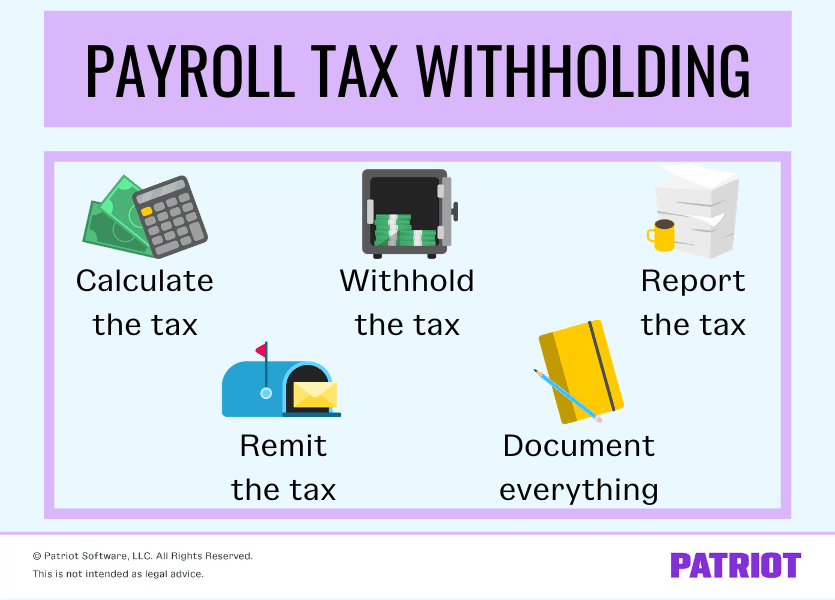
Here’s the lowdown on your responsibilities relating to payroll tax withholding:
- Calculate the tax
- Withhold the tax
- Report the withheld tax
- Remit the tax to agencies
- Document everything
1. Calculate the tax
The first step of payroll tax withholding is to calculate the tax.
Again, Social Security and Medicare taxes are standard percentages. Social Security tax is 6.2% of an employee’s wages until they reach the Social Security wage base. Medicare tax is 1.45% of an employee’s wages. If the employee earns above the Medicare threshold, you must withhold an additional 0.9% of their wages for additional Medicare tax.
Federal income tax is based on the employee’s Form W-4. If applicable, state income tax is based on the employee’s state W-4 form. Local income taxes either use a flat rate or a progressive tax rate.
Manually calculating payroll taxes can be time consuming and leave room for errors, especially if the employee’s wages and hours change. To help calculate the tax, consider using payroll software.
Shopping for software? Know what to look for. Download our free guide, “9 Things to Consider When Choosing Your Payroll Software,” for the scoop!
2. Withhold the tax
After calculating the payroll tax, you have to hang onto withheld payroll taxes until the time comes to deposit it with the IRS and your state and locality.
When it comes to payroll tax withholding, you have a few options. You can:
- Deposit the payroll tax liability in your business bank account
- Deposit it in a separate payroll bank account
- Use a payroll service to handle the withheld payroll taxes
However you choose to handle the withheld tax, put it in safekeeping. Don’t spend the money. Remember, the withheld tax is a liability that you must remit to the agencies by the due dates.
3. Report the withheld tax
The next part of payroll tax withholding is knowing how to file employee taxes. Report the withheld tax to the IRS, SSA, your state and/or locality (if applicable), and employees.
Take a look at the following documents you report payroll tax withholding on:
- Form 941 or 944 (IRS)
- Form W-2 (employee, SSA, state, and locality)
Consult your state and locality to learn how to report withheld payroll taxes throughout the year. Pay attention to your federal, state, and local reporting deadlines.
4. Remit the tax to agencies
In addition to reporting payroll tax withholding to the appropriate agencies, you must also deposit the tax.
Deposit withheld payroll taxes to the:
- IRS
- State
- Locality
Pay attention to federal, state, and local deposit deadlines to avoid penalties. Federal deadlines are based on whether you are a monthly or semiweekly depositor. Consult your state and locality for state- and local-specific deadlines.
5. Document everything
One of the most important parts of payroll withholdings is to document everything. Keep employee-related records such as:
- Pay rate
- Hours worked
- Gross wages
- Taxes withheld
- Net wages
Also, make copies of the following forms for your records, and keep them in a secure location:
- W-4
- W-2
- 941 or 944
- State-specific forms
- Local-specific forms
Who pays which payroll taxes? Employee vs. employer
Payroll taxes fall into two groups. Withheld taxes come out of your employee’s pay. Employer taxes are costs you pay on top of wages.
Some taxes have both parts. Social Security and Medicare are split evenly. You withhold half from the employee and pay the other half yourself.
Who pays table
| Tax | Withheld from Employee | Paid by Employer | Rate and Wage Base |
|---|---|---|---|
| Federal income tax | Yes | No | Based on the employee’s Form W-4 and IRS tables |
| Social Security | 6.2% | 6.2% | Wages up to threshold |
| Medicare | 1.45% | 1.45% | All wages, no limit |
| Additional Medicare | 0.9% | No | Wages over $200,000 |
| FUTA (federal unemployment) | No | Yes | 6.0% on the first $7,000, usually 0.6% after the state credit |
| State income tax | Yes, where it applies | No | Varies by state |
| SUTA (state unemployment) | No, in most states | Yes, in most states | Rate and wage base vary by state |
| Local taxes | Varies | Varies | Varies by location |
A few states, including Alaska, New Jersey, and Pennsylvania, also collect some unemployment tax from employees. Check your state agency.
A paycheck example
Let’s say you pay one employee $2,000 gross for a biweekly pay period. The federal income tax, state income tax, and SUTA rate below are examples only. Your amounts depend on the employee’s W-4 and your state.
What you withhold from the employee
| Item | Amount |
|---|---|
| Gross pay | $2,000.00 |
| Social Security (6.2%) | $124.00 |
| Medicare (1.45%) | $29.00 |
| Federal income tax (example) | $150.00 |
| State income tax (example) | $60.00 |
| Net pay | $1,637.00 |
What you pay on top
| Item | Amount |
|---|---|
| Social Security match (6.2%) | $124.00 |
| Medicare match (1.45%) | $29.00 |
| FUTA (0.6%, until the employee reaches $7,000 in wages) | $12.00 |
| SUTA (example rate of 2.7%) | $54.00 |
| Employer payroll taxes | $219.00 |
Your total cost for this paycheck is $2,219. That’s the $2,000 in wages plus $219 in employer taxes. The employee takes home $1,637.
What is FUTA?
FUTA stands for the Federal Unemployment Tax Act. Only you pay it. You never withhold it from an employee.
The rate is 6.0% on the first $7,000 you pay each employee. Most employers get a 5.4% credit for paying state unemployment tax on time. That lowers the rate to 0.6%, or $42 per employee per year.
If your business is in a credit reduction state, your credit is smaller, and you owe more. The IRS lists those states each year. You report FUTA on Form 940.
What is SUTA?
SUTA stands for State Unemployment Tax Act. Each state sets its own rate and wage base. New employers often get a standard starting rate. Your rate can change based on your claims history.
In most states, only the employer pays SUTA. Look up your rate with your state workforce agency.
Frequently asked questions
No. You withhold only the employee’s share from their pay. You pay your matching share of Social Security and Medicare from your own funds.
No. FUTA is an employer-only tax. It never reduces an employee’s net pay.
Withheld taxes come out of the employee’s wages. They include federal income tax, state income tax, and the employee’s half of Social Security and Medicare. Employer payroll taxes are what you pay on top of wages. They include your half of Social Security and Medicare, FUTA, and SUTA.
No. Employer taxes are an added business cost. Only withholdings lower the employee’s take-home pay.
Confused about how much to withhold from an employee’s paycheck? Patriot’s payroll will do all the calculations for you. With Full Service Payroll, Patriot Software calculates, deposits, and files your federal, state, and local payroll taxes for you. Put your calculators away and get free, U.S.-based payroll setup and support, free workers’ comp integration, and so much more. Start your free trial today!
This article has been updated from its original publication date of July 29, 2015.