
- FUTA deposits are generally quarterly when your quarterly FUTA liability exceeds $500; if it’s under $500 for the quarter, roll it forward. If it’s under $500 for the entire year, you can pay with Form 940 by January 31.
- Federal income tax withholding, Social Security, and Medicare (FICA) deposits follow either a monthly (by the 15th of the following month) or semiweekly schedule set by the IRS lookback period.
- $100,000 next-day rule: If your accumulated liability hits $100,000 on any day, you must deposit the next business day, regardless of your normal schedule.
- Form 941 is due the last day of the month after each quarter; if all deposits are on time and in full, you get up to 10 additional calendar days to file.
- If a due date falls on a weekend or federal holiday, the deadline moves to the next business day.
- All federal payroll tax deposits must be made via EFTPS.
Withholding, remitting, and reporting payroll taxes are all a necessary part of being an employer. A big part of the responsibility of remitting these taxes is knowing when to pay them. After all, you don’t want to receive a letter from the IRS saying you missed a deadline.
The government decides when you must pay the taxes, but the due dates aren’t uniform for all taxes. So, let’s answer the question, “When are federal payroll taxes due?”
Note: This article covers federal payroll tax due dates. State and local payroll tax due dates vary by location.
2026 Payroll filing and deposit calendar (quick view)
Form 941 due dates in 2026:
- Q1 2026 (Jan–Mar): Due April 30, 2026
- Q2 2026 (Apr–Jun): Due July 31, 2026
- Q3 2026 (Jul–Sep): Due November 2, 2026 (Oct 31 falls on a weekend)
- Q4 2026 (Oct–Dec): Due January 31, 2027 (moves if weekend/holiday)
Timely filer extension: If you deposited all taxes on time and in full, you generally have up to 10 additional calendar days to file Form 941 (e.g., May 10, August 10, November 10; next business day if weekend or holiday).
Monthly depositors: Deposit by the 15th of the following month (next business day if weekend/holiday).
Semiweekly depositors: Wednesday – Friday paydays deposit by the following Wednesday; Saturday – Tuesday paydays deposit by the following Friday.
Overview: When are federal payroll taxes due?
Again, the government mandates the federal payroll tax due dates for each business. The due dates for your business can depend on different factors (e.g., total tax liabilities). There are two main types of federal payroll-related taxes you must remit:
- Federal unemployment tax (FUTA)
- Federal income, Social Security, and Medicare taxes*
*Remember that Social Security and Medicare taxes are part of the Federal Insurance Contributions Act (FICA), and both employers and employees pay these taxes. You must withhold and remit federal income taxes on behalf of your employees.

Take the worry out of depositing and filing your federal payroll taxes with Patriot’s Full Service payroll software. We collect, deposit, and file your taxes for you.

FUTA tax
As an employer, part of your employer responsibility is filing and paying FUTA tax. Because it is an employer-only tax, do not withhold FUTA taxes from your employees’ wages. FUTA taxes fund the federal government’s administration of state unemployment programs.
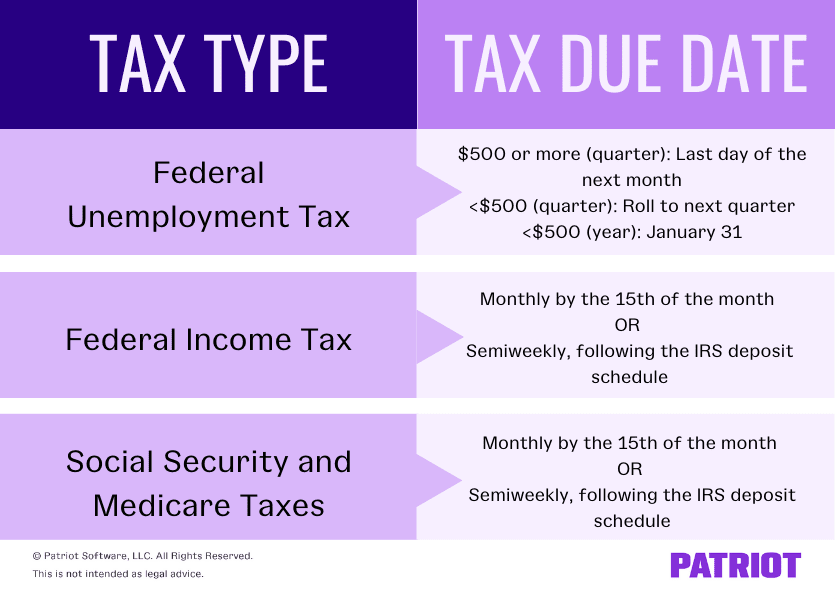
Generally, FUTA taxes are due quarterly. But, when you must pay FUTA tax also depends on your FUTA tax liability for the current quarter:
More than $500 in the current quarter: If your FUTA tax liability is more than $500 for the current tax quarter, deposit the funds by the last day of the month after the end of the quarter. For example, the first quarter ends on March 31. Your FUTA tax liability is due on April 30 for Quarter 1 (the last day of the month following the end of the first quarter).
Less than $500 in the current quarter: If your FUTA tax liability is less than $500 for the current quarter, roll the funds over into the next quarter. When your current quarter’s FUTA tax liability and the total amount of rolled over funds add up to more than $500, deposit the tax. If your FUTA liability is less than $500 for the entire year, deposit the funds separately or with Form 940 by January 31.
When are payroll taxes due? Check out the quarters and due dates for each quarter:
| Quarter | Quarter End Date | FUTA Tax Due Date |
|---|---|---|
| Quarter 1 (January, February, March) | March 31 | April 30 |
| Quarter 2 (April, May, June) | June 30 | July 31 |
| Quarter 3 (July, August, September) | September 30 | October 31 |
| Quarter 4 (October, November, December) | December 31 | January 31 |
If the due date falls on a weekend or banking holiday, the deposit is due the next business day.
Federal income, Social Security, and Medicare taxes
When are federal withholding taxes due? And, when are Social Security and Medicare taxes due? The good news is that all three of these taxes are due at the same time. The bad news is that the due date depends on your business and when the IRS tells you to pay the taxes.
But, there’s good news again! There are only two deposit schedules: semiweekly or monthly. Every employer must use one of these schedules. You do not get to choose your schedule. When to pay federal payroll taxes depends on the IRS’s guidelines. The IRS bases your deposit schedule on a lookback period.
If you are a monthly depositor, deposit all federal income, Social Security, and Medicare taxes (both employee and employer) by the 15th day of the following month. For example, taxes you incur in January are due by February 15. If the 15th day falls on a banking holiday or weekend, deposit on the next business day.
Remember that the pay date plays a role in paying the taxes if you’re a monthly depositor. For example, you pay your employees semimonthly. You pay your employees on February 15 for the pay period January 15 through January 31. The taxes for that pay period are due March 15 because you paid your employees in February even though the pay period was in January.
Semiweekly depositors must follow a strict tax deposit schedule:
- If your payday is on Wednesday, Thursday, or Friday, you must deposit these taxes by the following Wednesday
- If your payday is on Saturday, Sunday, Monday, or Tuesday, you must deposit these taxes by the following Friday
To learn even more about monthly and semiweekly deposit schedules, check out IRS Publication 15.
$100,000 next-day rule:
- If your accumulated tax liability reaches $100,000 on any day, you must deposit the tax by the next business day, regardless of whether you are a monthly or semiweekly depositor.
- If a monthly depositor triggers the $100,000 rule, you become a semiweekly depositor for the remainder of that calendar year and the following year.
What is a lookback period?
A lookback period is a set period of time the IRS uses to review and determine your federal tax deposit schedule. How much you paid in federal payroll taxes during the lookback period determines your deposit schedule for the next tax year.
Your lookback period differs depending on what form your business files. The lookback period applies to either your Form 944 for that year (annual form) or to all four quarters on your Form 941 that year (quarterly form).
New employers have no tax liability during the lookback period. Because of this, all new employers start as monthly depositors.
Form 941
Form 941 is the quarterly form that many employers use to report their federal income, Social Security, and Medicare tax liabilities.
If you are a Form 941 filer, your lookback period is a four-quarter period that begins on July 1 and ends on June 30 of the following year. For example, the lookback period to determine your 2026 payroll tax deposit schedule is July 1, 2024 to June 30, 2025.
Using the lookback period, figure out the total amount of your tax deposits during that time. You are a monthly depositor if you paid $50,000 or less in taxes during the lookback period. You are a semiweekly depositor if you paid more than $50,000 in taxes during the lookback period.
Form 944
Form 944 is an annual form that some employers use to report their federal income, Medicare, and Social Security tax liabilities. Do not file this form unless the IRS tells you to.
The Form 944 lookback period applies to anyone who is a Form 944 filer in the current year or either of the two preceding years. The lookback period is the second preceding calendar year. For example, the lookback period for 2026 deposits is the 2024 calendar year.
Calculate your total tax liability for the lookback period. If your liability was $50,000 or less, you are a monthly depositor. If your liability was more than $50,000, you are a semiweekly depositor.
How do you pay federal payroll taxes?
You must pay all FUTA, federal income, Social Security, and Medicare taxes using the Electronic Federal Tax Payment System (EFTPS).
EFTPS tips:
- Enroll early: EFTPS enrollment and PIN activation can take several business days.
- Scheduling cutoff: To be on time, schedule payments by 8 p.m. Eastern Time the day before the due date.
- Missed the cutoff? You may be able to make a same-day wire payment through your financial institution (fees may apply).
Streamline your payroll process with Patriot Software
Patriot’s Full Service Payroll helps you:
- Calculate and withhold the correct federal payroll taxes each run
- Deposit taxes and file federal forms (e.g., Forms 941 and 940) on your behalf
- Generate reports of taxes filed and paid on your behalf
FAQs
Q1 2026 is due April 30, 2026; Q2 2026 is due July 31, 2026; Q3 2026 is due November 2, 2026; Q4 2026 is due February 1, 2027. If all deposits are on time and in full, you generally have up to 10 extra calendar days to file.
Check your lookback period. If your total tax liability during the lookback period is $50,000 or less, you’re monthly; over $50,000, you’re semiweekly. New employers start as monthly depositors.
If your accumulated tax liability reaches $100,000 on any day during a deposit period, you must deposit the taxes by the next business day. Monthly depositors who trigger this become semiweekly depositors for the rest of the year and the next year.
Deposit by the last day of the month after the quarter if your quarterly FUTA liability exceeds $500. If it’s under $500, roll it to the next quarter. If your total FUTA liability for the year is under $500, you can pay with your annual Form 940 by January 31.
Use EFTPS. Enroll early, schedule by 8 p.m. ET the day before the due date, and consider a same-day wire if you miss the scheduling cutoff. Consider signing up for full-service payroll to handle payroll tax deposits on your behalf.
Deposits and filings due on a weekend or federal holiday move to the next business day.
Failure-to-deposit penalties generally start at 2% (1–5 days late), 5% (6–15 days late), 10% (more than 15 days late or if not deposited via EFTPS when required), and up to 15% if not paid after the first IRS notice. Interest may also apply.
This article has been updated from its original publication date of February 15, 2017.
This is not intended as legal advice; for more information, please click here.