
Does your business have enough liquid assets to cover short-term liabilities in a pinch? To find out, you can use the quick ratio. Keep reading to learn the quick ratio definition, how to calculate your ratio, and more.
- Quick ratio measures a company’s ability to cover short-term liabilities with highly liquid assets.
- Formula: (Cash + Marketable Securities + Accounts Receivable) ÷ Current Liabilities.
- A ratio of 1 or more indicates sufficient liquidity; below 1 suggests potential short-term shortfall.
- Too high a ratio may signal excess idle cash; ideal levels vary by industry and circumstances.
What is quick ratio?
The quick ratio (aka liquidity ratio or acid test ratio) measures liquidity and evaluates whether your business has enough liquid assets that you can convert into cash to pay short-term liabilities. The ratio includes “quick assets” that you can quickly convert into cash, such as:
- Cash and cash equivalents
- Accounts receivable (i.e., amounts owed to the business)
- Marketable securities (e.g., stocks and bonds)
Your ratio can tell you how well your business can pay its short-term liabilities by having assets that are readily convertible into cash.
Quick ratio vs. current ratio
Ever heard of the current ratio? If so, you may be wondering how it differs from the quick ratio.
A current ratio tells you the relationship of your current assets to current liabilities. The ratio looks at more types of assets than the quick ratio and can include inventory and prepaid expenses.
The quick ratio only includes highly-liquid assets or cash equivalents as current assets. It does not include other current assets, like inventory.
Both the quick and current ratios measure your company’s short-term liquidity. However, they do not have the same formulas and don’t include all of the same assets.

Calculating quick ratio
How to calculate quick ratio:
- Choose a quick ratio formula (any of these works)
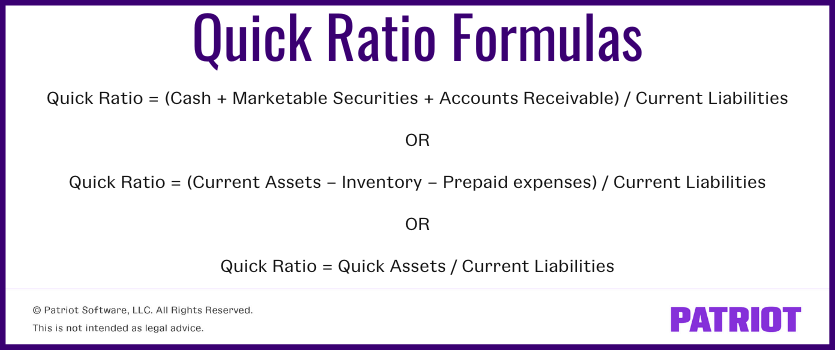
Quick Ratio = (Cash + Marketable Securities + Accounts Receivable) / Current Liabilities
Quick Ratio = (Current Assets – Inventory – Prepaid Expenses) / Current Liabilities
Quick Ratio = Quick Assets / Current Liabilities - Gather the numbers from your balance sheet
– Cash
– Marketable securities
– Accounts receivable
– Current assets (if applicable)
– Inventory (if applicable)
– Prepaid expenses (if applicable)
– Current liabilities - Calculate quick assets, if needed
If you’re using the “quick assets” version, compute:
Quick Assets = Cash + Marketable Securities + Accounts Receivable - Confirm what you’re including in current liabilities
Common examples include accounts payable, short-term debt, and notes payable.
- Plug values into your chosen formula
– Calculate the numerator and divide by Current Liabilities
Keep in mind that quick assets include cash, marketable securities, and accounts receivable. Current liabilities can include accounts payable, short-term debt, and notes payable.
Quick ratio example
Let’s say your business has the following:
- Cash: $25,000
- Accounts receivable: $16,000
- Marketable securities: $13,000
- Accounts payable: $12,000
- Short-term debt: $6,000
To find your company’s quick ratio, first add together your cash, accounts receivable, and marketable securities to find your quick assets. Add together your accounts payable and short-term debt to find current liabilities. Then, divide your quick assets by current liabilities to find your quick ratio.
Quick Ratio = ($25,000 + $16,000 + $13,000) / $18,000
Quick Ratio = 3
Your business’s quick ratio is three ($54,000 / $18,000). This means your company is liquid and can generate cash quickly. But, what does a good quick ratio look like?
What is a good quick ratio?
When it comes to the quick ratio, generally the higher it is, the better. As a business, you should aim for a ratio that is greater than or equal to one.
A ratio of 1 or more shows your company has enough liquid assets to meet its short-term obligations. A less than one ratio indicates that a business doesn’t have enough liquid assets to cover its current liabilities within a short period.
Although you want your ratio to be high, you don’t want it to be too high. A quick ratio that is too high could mean that your business is sitting on too much cash and not investing or growing enough.
Keep in mind that industry, location, markets, etc. can also play a role in what a good quick ratio is. Some industries may have a higher or lower quick ratio than others. Do your research to find out what ratio your business should be aiming for.
Patriot Software’s easy and affordable accounting software gives you the reports you need to determine your business’s financial health. Start a free trial today!
This article has been updated from its original publication date of August 1, 2017.
This is not intended as legal advice; for more information, please click here.