
Do you have freelancers or contractors working for you? Is your labor force full of short-term contracts? You might be working in a gig economy with gig workers. If so, you need to know the laws for hiring gig workers. Keep reading to learn more about the gig economy.
- Gig workers are independent contractors, not employees. You generally don’t withhold taxes or offer benefits, and you may need to issue Form 1099-NEC if you pay $600+ in a calendar year.
- Correct classification depends on control, financial arrangement, and the overall relationship (IRS and FLSA factors). Misclassification can trigger penalties.
- To pay contractors: collect Form W-9 before the first payment, agree on scope/rate/terms in writing, pay per contract, and send required 1099 forms by January 31.
- Modern payroll software can manage both W-2 and 1099 workers, enable fast payouts, automate year-end forms, and reduce compliance risk.
What is a gig economy, and who are gig workers?
Let’s define gig economy first. The gig economy meaning is a labor market where freelance, temporary, or independent contract work is common. Full-time, permanent positions are not part of the gig economy. The term “gig” comes from musicians and describes a job that lasts for only a specified period of time.
Now, let’s define gig worker (sometimes incorrectly called a gig employee). A gig worker is someone you hire to perform temporary or freelance work for your business. Gig workers are typically treated as independent contractors for tax and labor purposes and usually receive 1099 forms (not W-2s).
So if you have any freelancers, temporary workers, or 1099 contractors, you have gig workers. There are many types of gig workers, and common gig workers examples include:
- Ride-sharing drivers (e.g., Uber)
- Consultants
- Handymen
- Fitness / personal trainers or coaches
- Tutors
- Performers
- Photographers
- Graphic designers
- Web developers
- Writers
- Delivery couriers
- On-demand service providers
The gig economy consists of individuals who are not on payroll. Because they are not on payroll, you send payments to these freelancers without deducting any taxes or paying employer taxes.
How does the gig economy work?
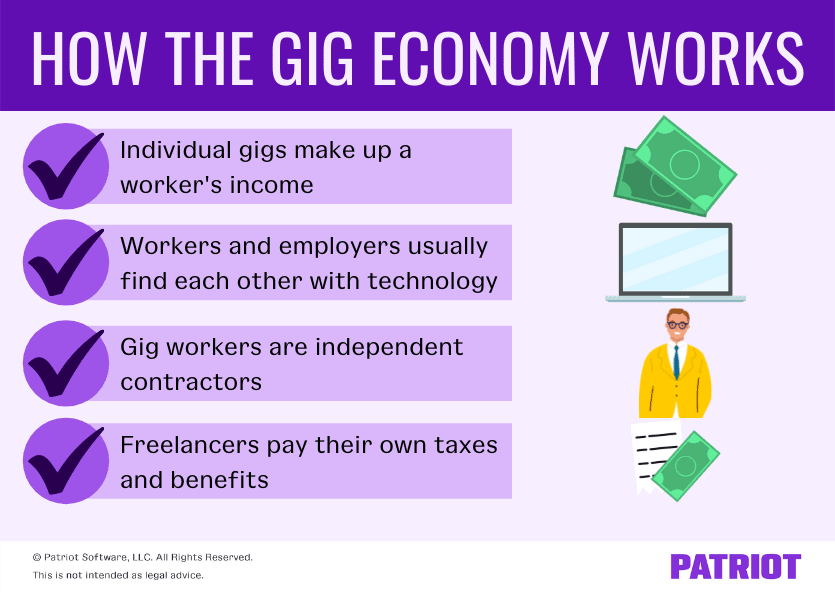
The gig economy is a free market system that allows individuals to earn wages for short-term work. Employers contract out specific jobs and hire workers as 1099 contractors. Here is how the gig economy works:
- Individual gigs make up gig workers’ income
- Employers and contractors typically find each other via technology (e.g., job boards)
- Workers are independent contractors
- Freelancers pay their own benefits and taxes
In many cases, apps and platforms facilitate matching, onboarding, and payment, but the underlying classification rules still apply.
Individual gigs make up gig workers’ income
The nature of gig work is that it is temporary work. So, gig economy workers may work multiple gigs in a year to create a total yearly income.
Each gig economy job is a small portion of the total income. When added together over the course of a year, the gig worker’s pay is similar to a full-time employee’s.
Employers and contractors typically find each other via technology
Not all employers find gig workers using technology or the internet. But, the world is heavily reliant on digital means, so finding gig workers online might be easiest for your business.
The days of posting on physical job boards have gone by the wayside. Consider posting your opportunities on social media (e.g., LinkedIn) or digital job boards (e.g., Indeed).
Workers are independent contractors
As a 1099 contractor, a gig worker performs work independently of employment contracts. Quick classification snapshot: If the worker controls how and when work is done, brings their own tools, and can profit or lose based on their efficiency, they’re more likely an independent contractor.
Freelancers pay all their own benefits and taxes
Because gig workers are not employees, employers do not withhold taxes or provide benefits (we’ll get to that later). Instead, gig workers are self-employed individuals who must pay taxes and benefits on their own.
What is the difference between an employee and a gig worker?
At a glance:
- Employee: You control schedule/process, provide tools/benefits, and withhold/pay payroll taxes (W-2).
- Gig worker (independent contractor): They control how work is done, set/accept rates, supply tools, and handle their own taxes (1099).
When hiring gig workers for your business, you may be asking yourself what the difference is between a contractor and an employee. The IRS and the Fair Labor Standards Act (FLSA) have specific criteria for classifying contractors and employees.
IRS rules on gig workers
The IRS has three main criteria for distinguishing between employees and gig workers, including:
- Behavioral
- Financial
- Type of relationship
As the employer, consider how much control you have over the worker to determine if the worker should be a contractor.
Behavioral
The basis of the behavioral criteria is whether or not your company has the ability and right to control how the contractor works. Do you get to determine what the worker does and how they complete the assignment?
If you have control over the project and the employee’s work (and how they do it!), you likely have an employee. If you do not have control over the worker and how they complete the project, the worker is likely a contractor.
Financial
Financial control depends on whether or not you can control other business aspects of the worker’s job. For example, a gig employee tells you their fees for performing the work upfront and typically brings their own equipment.
If you determine the payment amount for the worker and/or supply all of the materials for the work, you may have an employee. Payments can be negotiable with employees, but generally, you set the terms (e.g., a set hourly wage).
Type of relationship
One of the easiest ways to differentiate between employees and gig workers is the type of working relationship. Ask questions like:
- Do I provide any benefits to the worker (e.g., a retirement plan)?
- Will our working relationship continue after the project is completed?
- Are there any written contracts regarding the type of employment?
Generally, you do not provide employee benefits to contractors, and the working relationship ends once the project is done because the work is temporary.
You can have written contracts with employees and contractors, but the type of contract determines the relationship. Generally, if you provide the agreement outlining the terms of employment and the pay, you probably have an employee. But if the worker gives you a contract outlining the work and the payment amount, you may have a contractor.
FLSA rules on gig workers
In addition to the IRS’s regulations, the Fair Labor Standards Act (FLSA) provides six factors to help you determine your worker’s employment status, including:
- If the work performed is an integral part of your business
- If the worker’s managerial skills affect their opportunity for profit and loss
- The worker’s investments in the business’s facilities and equipment
- If the work requires specialized skills and initiative
- The permanency of the work
- The nature and degree of control you have over the worker
Employers must look at all six points to determine worker classification, not just one. Contact the Department of Labor for more information.
Note: The Department of Labor’s 2024 independent contractor rule emphasizes a “totality of the circumstances” approach; no single factor determines worker status. Evaluate how the factors fit together in your specific situation.
State laws regarding contractors
Some states have their own laws regarding who can and cannot be classified as a contractor. For example, California has the California AB 5 law that requires most industries to use the ABC test to determine if a worker is a contractor.
Other states, like Massachusetts and New Jersey, have similar laws. Maine also has an ABC test law for unemployment compensation determinations.
Some states also have industry-specific carveouts or separate rules for app-based drivers and delivery partners. Always check your state’s latest guidance.
The ABC test says that a worker is only an independent contractor if they meet all three parts of the test (aka A, B, and C). Those three parts are:
- A worker is free from the control and direction of the hirer concerning the performance of the work, both under the contract and in fact (i.e., the employer does not have behavioral control)
- The worker performs work that is outside the usual course of the hirer’s business
- The worker is customarily engaged in an independently established trade, occupation, or business of the same nature as the work performed for the hirer
Let’s look at two examples, one of an employee and one of a gig worker.
You own a retail business selling clothing and offer tailoring services for the clothing you sell. As part of your operations, you need to hire a professional photographer and a seamstress. Which is the employee, and which is the contractor?
Using the ABC test, you determine that the seamstress must be an employee. Why? Because they perform work in line with the services you offer.
In contrast, the photographer is an independent contractor. Why? Because the photographer performs a project outside of the services you provide, is not under your behavioral control, and is engaged in an independent trade of the same kind they offer to you.
How do you pay gig workers?
Now that you’ve determined you have a gig worker, you might be wondering just how you pay them. Gig workers do not carry the same responsibilities as employees when it comes to paying them. Do not withhold taxes, pay employer taxes, or deduct any benefits from a gig worker.
Paying contractors step by step:
- Collect Form W-9 before the first payment (legal name, address, and TIN).
- Agree on scope, deliverables, rate, invoicing method, and payment schedule in writing.
- Set a payment method (ACH/direct deposit, instant transfer, check, or digital wallet) and terms (e.g., Net 15).
- Review and approve invoices or milestones; pay according to the contract.
- Track total payments per contractor across the year.
- Issue required year-end forms (typically 1099-NEC) by the deadlines.
When you hire the independent contractor, have them complete a Form W-9 and issue a Form 1099 at the end of the year. Typically, you distribute a Form 1099-NEC. Most payors must issue Form 1099-NEC to U.S. contractors paid $600 or more for services in a calendar year. Furnish copies to contractors and the IRS by January 31. If a contractor doesn’t provide a valid TIN on Form W-9, backup withholding may apply.
If you pay contractors through certain third-party payment networks, the platform may be responsible for Form 1099-K reporting. Confirm responsibilities before year-end.
Payroll solutions for gig workers
Modern payroll and payout tools can make contractor management simpler and faster. Look for:
- Flexible payout options: direct deposit payments to gig workers.
- Speed and reliability: On-demand or scheduled payouts reduce payment delays and improve contractor satisfaction.
- Multi-worker management: Manage W-2 employees and 1099 contractors in one system, with separate tax treatment.
- Automation and compliance: Prepare 1099-NEC forms.
Best for scenarios:
- Small teams hiring occasional freelancers: Simple contractor payments with basic 1099 prep.
- Growing businesses with mixed workforces: Unified system for W-2 and 1099, faster payouts, and automated filings.
How Patriot can help:
- Use Patriot’s accounting and payroll software to pay contractors, track year-to-date totals, and create the 1099 forms you need. This reduces manual work and helps you stay organized at year-end.
Compliance checklist for hiring gig workers
- Classification: Apply IRS/FLSA factors and any state ABC test.
- Written agreement: Scope, deliverables, rate, ownership, confidentiality, and payment terms.
- Tax forms: Collect Form W-9 before the first payment; verify TIN as needed.
- Payment method: Set up payments and due dates; define approval steps.
- Tracking: Monitor payments per contractor for 1099 thresholds.
- Year-end: Issue 1099-NEC forms by January 31 (to the contractor and IRS).
- Records: Keep contracts, W-9s, invoices, and payment proofs in your files.
- State rules: Check requirements in your state.
FAQs
A gig worker typically performs project-based or short-term services as an independent business, controls how work is done, and is paid on a per-project, per-milestone, or per-hour basis without payroll tax withholding.
Generally yes, if you pay a U.S. contractor $600 or more for services in a calendar year. Provide copies to the contractor and the IRS by Janury 31.
No, gig workers properly classified as contractors are not W-2 employees, so you do not handle payroll. However, some payroll software systems let you pay contractors alongside employees.
Pay contractors according to your contract with them. Common options include per milestone, per deliverable, weekly, biweekly, or monthly. Faster payouts can help you attract and retain quality contractors.
Typically no. Offering employee benefits or exerting significant control can signal employee status. Keep benefits and controls appropriate to an independent contractor relationship.
Keep the signed agreement, Form W-9, invoices, proofs of payment, and communication documenting scope/deliverables.
Back taxes, penalties, interest, and potential wage-and-hour claims. Review classification carefully and consult a professional when in doubt.
Yes. Some states use the ABC test or have special rules for certain industries. Check your state’s latest guidance in addition to federal rules.
Paying gig workers and issuing their tax documents at the end of the year can be confusing. Make it simple with Patriot’s online accounting software. Add your vendors, enter payments, and print checks in a few easy steps.
This article has been updated from its original publication date of June 17, 2021.
This is not intended as legal advice; for more information, please click here.