
Do you need to withhold money from employee wages beyond taxes (e.g., garnishments or benefits)? Then you might be wondering when exactly you deduct the employee’s contributions (before or after taxes). Well, it depends. For accurate withholding, understand what are pre-tax deductions.
Not sure what that means or how it impacts your tax calculations? We’ve got you covered.
- A pre-tax deduction is taken from gross pay before calculating certain taxes, which reduces taxable wages.
- Common pre-tax benefits include health insurance (via a Section 125 plan), HSA/FSA, some commuter benefits, and certain retirement contributions.
- Not all pre-tax benefits reduce all taxes. For example, 401(k) deferrals reduce federal income tax but are still subject to Social Security and Medicare.
- Contribution limits and plan rules (often set by the IRS) determine how much can be excluded from taxation each year.
- Accurate setup in payroll (taxability flags per benefit) is critical to withhold the right amounts and report correctly on Form W-2.
| Pre-tax Deductions Definition |
|---|
| A pre-tax (before-tax) deduction is taken from gross wages before withholding any taxes. Pre-tax deductions help to lower an individual’s taxable wages and reduce taxes. Pre-tax deductions are payments that are deducted from employees’ pre-tax income, lowering their taxable income. These types of deductions go toward certain employee benefits. In short, withhold before-tax deductions before withholding taxes. Qualified pre-tax deductions can also include: – 401(k) contributions – Pre-tax health insurance – Educational assistance programs – Group-term life insurance These deductions can be offered as an employer-paid deduction, an employee-paid deduction, or a combination of the two. Some deductions are pre-tax up to a certain limit. Understand IRS rules on taxable benefits to stay compliant. |
What are pre-tax deductions?
A pre-tax deduction is money you remove from an employee’s wages before you withhold money for taxes, lowering their taxable income. Pre-tax deductions go toward employee benefits. Not all benefits are pre-tax deductions.
Many benefits are employee- and employer-sponsored, meaning both parties contribute to whatever premium, account, or program the employee has. But when you deduct the employee’s contribution from their wages, you do it either before or after taxes, depending on the type of benefit.
If you offer a range of employees benefits, chances are you’ll come across a pre-tax deduction. And, you’ll likely come across post-tax deductions, which are benefits you withhold after taxes.
Unlike post-tax deductions, pre-tax deductions benefit employees in more ways than one. Employees get to enjoy the benefit and reduce the amount of money they owe in taxes. Not to mention, employers also enjoy a tax reduction.
How do pre-tax deductions impact taxes?
Again, pre-tax deductions reduce an employee’s taxable wages. This often gives employees more spending money.
So, which taxes does a pre-tax deduction reduce? Pre-tax deductions can reduce an employee’s federal, state, and local taxes:
- Federal income tax
- FICA tax (Social Security and Medicare taxes)
- State income tax (if applicable)
- Local income tax (if applicable)
Pre-tax payroll deductions also lower federal unemployment tax (FUTA tax), which only employers pay. And, these deductions can lower state unemployment tax, which only employers pay (with some state exceptions).
Keep in mind that not all pre-tax deductions are completely tax free. Some deductions are exempt from federal income tax but not from FICA and FUTA taxes.
(Quick reference) Common tax effects at a glance:
- Health, dental, vision premiums under a Section 125 plan: Typically excluded from federal income tax, Social Security, Medicare, FUTA, and often state and local (where applicable).
- HSA contributions through payroll (Section 125): Typically excluded from federal income tax, Social Security, Medicare, FUTA; subject to annual IRS limits. Report employer HSA contributions in Box 12 (Code W).
- FSA contributions (health FSA, dependent care FSA): Generally excluded from federal income tax, Social Security, Medicare, and often state/local; subject to separate annual limits. Dependent care benefits appear on Form W-2, Box 10.
- 401(k)/403(b) employee deferrals: excluded from federal income tax, but generally subject to Social Security, Medicare, and FUTA;
- subject to annual IRS limits and catch-up amounts.
- Commuter benefits (transit, parking) under Section 132(f): Excluded from taxable wages up to monthly IRS limits; excess amounts are taxable.
State and local rules vary. Always confirm plan document requirements (e.g., having a valid Section 125 plan in place for pre-tax health deductions).
Example
Say you have an employee with a pre-tax deduction. The deduction is $50 per payroll, and you pay the employee a gross pay of $1,000 per biweekly pay period.
First, subtract the $50 pre-tax withholding from the employee’s gross pay ($1,000):
$1,000 – $50 = $950
The employee’s taxable income is $950 for the pay period. You can now withhold taxes on $950 rather than $1,000.
Future taxation
Even though there is no tax now, employees might owe taxes on pre-tax benefits later, like when they go to use the benefit.
For example, an employee has a pre-tax retirement account. You withhold the money before taxes and deposit it into the account. When the employee retires and uses the saved funds, they will owe taxes on the amount.
Limits
Some benefit deductions are only pre-tax up to a certain amount. This means that the deduction is exempt from taxation until the employee reaches an IRS contribution or tax-exempt limit. The IRS limit for each type of pre-tax deduction with a threshold is subject to change annually.
For example, health savings account deductions have an annual IRS contribution limit that’s exempt from taxes.
How to calculate payroll with pre-tax deductions (step-by-step)
How to calculate payroll with pre-tax deductions:
- Start with gross pay
– Hourly: Hours x rate (plus overtime/premiums as applicable).
– Salary: Salary for the pay period. - Subtract applicable pre-tax deductions
Apply each benefit’s taxability rules. For example, Section 125 health premiums reduce federal income tax, Social Security, and Medicare wages; 401(k) deferrals reduce federal income tax only.
- Determine taxable wages by tax type
– Federal income tax wages: Gross pay minus FIT-excludable pre-tax deductions (e.g., 401(k), Section 125 premiums).
– Social Security/Medicare wages: Gross pay minus FICA-excludable pre-tax deductions (e.g., Section 125 premiums, certain FSAs/HSAs), but include 401(k) deferrals.
– State and local wages: Follow state/local rules; many mirror federal, but some differ. - Calculate withholdings and employer taxes
– Withhold federal, state, and local income taxes and FICA tax on the appropriate taxable wage base.
– Calculate employer FICA and unemployment taxes on their applicable bases. - Verify limits and adjust if needed
Stop pre-tax exclusions once the employee hits an IRS or plan limit (annual or monthly, depending on the benefit).
- Report on Form W-2
Ensure required boxes and codes (e.g., HSA Code W, dependent care Box 10) are populated according to IRS instructions.
Pre-tax deductions list
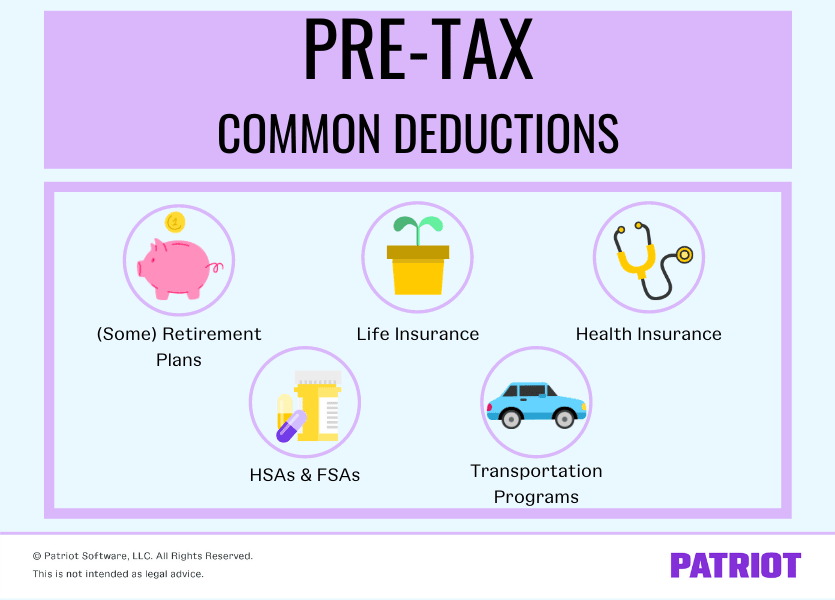
So, what deductions are pre-tax? A number of fringe benefits allow pre-tax deductions. Below is a pre-tax deductions list of common employee benefits.
Retirement plan contributions
Some retirement plans are eligible for pre-tax deductions, such as certain IRAs and 401(k) plan types. This lets employees save for retirement and reduce their taxable income.
Pre-tax retirement accounts are typically exempt from all employment taxes. Check the specific plan you offer for more details. Keep in mind that employee 401(k) and 403(b) deferrals reduce federal income tax but are generally still subject to Social Security, Medicare, and FUTA. Verify the exact taxation for your specific plan in your payroll system.
Retirement plans have IRS contribution requirements and limits that change annually. There is an additional contribution limit for workers over a certain age.
Although some retirement plans are pre-tax deductions, employees must pay the taxes when they receive distributions.
Keep in mind that not all retirement plans are pre-tax. Roth IRA and Roth 401(k) contributions are post-tax deductions. This requires employees to pay taxes on them before you withhold them. However, the employee does not owe taxes on distributions.
Health insurance premiums
You might be able to withhold health insurance premiums before taxes, especially if the health benefits are part of a Section 125 plan.
Common pre-tax health-related insurance benefits include:
- Health insurance
- Accident insurance
- Dental insurance
- Vision insurance
For the most part, health benefits are pre-tax. Some health benefits have contribution limits or special tax withholding rules. Employee premium contributions are typically pre-tax only when a valid Section 125 cafeteria plan is adopted by the employer. Without a Section 125 plan, employee-paid premiums are usually after-tax.
HSA and FSA contributions
Do your employees contribute to a health savings account (HSA) or flexible spending account (FSA)? If so, their contributions are pre-tax deductions.
Both HSAs and FSAs are accounts employees can contribute to and use to fund qualifying medical expenses, such as copays and deductions. These accounts help employees to save for medical expenses insurance doesn’t cover and reduce their taxable income.
The IRS sets an annual contribution limit for an HSA and FSA. Like retirement plans, individuals above a certain age can contribute more to their account.
Quick notes:
- HSA contributions made through payroll (or by the employer) are generally excluded from federal income, Social Security, and Medicare taxes and are reported in Box 12 (Code W).
- Health FSAs are pre-tax up to annual plan limits. Dependent care FSAs follow separate annual limits and appear on Form W-2, Box 10.
Life insurance premiums
Group-term life insurance is exempt from all employment taxes. However, it is only exempt from FICA taxes up to the cost of $50,000 of coverage.
Premiums must go toward life insurance that:
- Provides a general death benefit
- Is provided to a group of at least 10 full-time employees
- The employer carries, either directly or indirectly
The cost of employer-provided group-term life coverage over $50,000 (known as imputed income) is taxable and typically subject to Social Security and Medicare. Amounts at or below $50,000 are generally excluded.
Transportation program contributions
Transportation, or commuter, benefits are pre-tax deductions that can cover an employee’s transportation-related expenses.
Qualifying transportation expenses include:
- Transit passes for public transportation (e.g., buses, trains, subways, etc.)
- Parking expenses (e.g., parking at or near work)
Depending on the types of commuter benefits you offer, there might be limits. Once the benefit reaches that limit, it is no longer exempt from taxes.
Reminder: Section 132(f) sets monthly limits for transit and parking. Amounts above the monthly limit are taxable wages and subject to withholding.
Understanding housing allowances for pastors
A pastor’s housing allowance (also called a parsonage or rental allowance) is a church-designated portion of a minister’s compensation intended for housing costs at the minister’s primary residence. Key points:
- Tax treatment: Generally excludable from federal income tax under Internal Revenue Code Section 107, but typically included in self-employment tax (Social Security/Medicare via SECA) for ministers.
- Eligibility: Applies to duly ordained, commissioned, or licensed clergy performing ministerial duties.
- Designation: Must be officially designated in advance (e.g., by church board resolution) for a stated amount; not retroactive.
- Limit: The exclusion is limited to the lesser of (1) the designated allowance, (2) actual qualified housing expenses, or (3) the fair rental value of a furnished home plus utilities.
- Documentation: Churches should retain the designation; ministers should keep receipts and records of actual expenses. Any excess over actual expenses is taxable income.
- Payroll tip: A housing allowance is not a typical “pre-tax payroll deduction.” It’s a compensation designation that affects income tax exclusion for ministers. Churches often do not withhold FICA for ministers (ministers pay self-employment tax), but ministers may request voluntary federal income tax withholding.
FAQs
Money taken from an employee’s gross pay before certain taxes are calculated, reducing taxable wages for those taxes.
No. For example, 401(k) deferrals reduce federal income tax but are usually still subject to Social Security and Medicare.
Yes. Employee premium contributions are typically pre-tax only if the employer adopts a valid Section 125 cafeteria plan.
Yes, up to annual limits. HSA and FSA payroll contributions are generally excluded from federal income tax, Social Security, and Medicare.
Transit and parking benefits can be pre-tax up to monthly IRS limits. Amounts above the limits are taxable.
It depends on the benefit. For example, employer and employee HSA amounts via payroll are reported in Box 12 (Code W). Dependent care benefits appear in Box 10. Many pre-tax amounts reduce taxable wages and will not appear as taxable compensation.
Any excess is generally taxable. Update elections and payroll settings to prevent further pre-tax withholding until the next plan year.
It’s excluded from federal income tax (up to the allowable limit) but typically included in self-employment tax for ministers. It’s not a standard pre-tax payroll deduction.
Don’t calculate pre-tax deductions yourself. Patriot Software’s online payroll will do all the calculations for you. Start your free trial now.
This article has been updated from its original publication date of 4/25/2012.
This is not intended as legal advice; for more information, please click here.