
If you have tipped employees, you want to make sure you pay them correctly. You might be able to take a tip credit, which lowers the minimum wage you have to pay tipped employees. But, you need to use the tip credit correctly to avoid potential lawsuits or penalties.
| Tip Credit Definition |
|---|
| A tip credit reduces the minimum wage an employer is responsible for paying for tipped employees who make up the difference through tips. Employers of tipped employees can take a tip credit toward the federal minimum wage and pay tipped employees a minimum cash wage. Tipped workers typically include those in restaurant and hospitality industries. The federal minimum wage is $7.25 USD per hour. The federal minimum wage for tipped employees is $2.13 per hour. The difference between the two, the actual “tip credit” is $5.12 per hour. |
What is a tip credit?
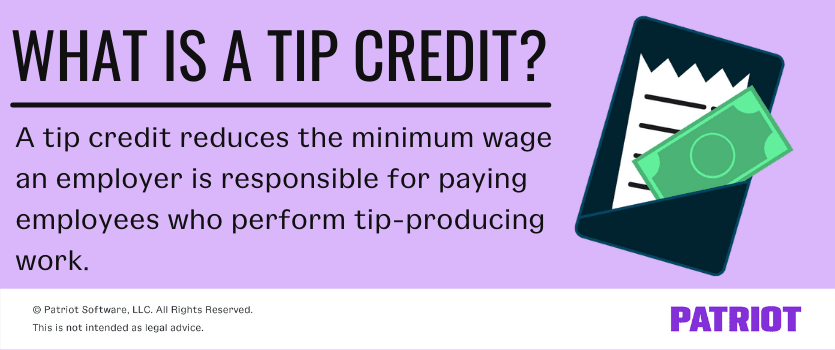
The Fair Labor Standards Act (FLSA) allows employers to take a tip credit toward the federal minimum wage. A tip credit means you can pay your tipped employees a lower wage than the federal minimum wage. This lower wage is called a minimum cash wage.
Here’s one way to think about the credit for tips:
Minimum Wage – Tip Credit = Minimum Cash Wage
You can take a tip credit because, ideally, tip income would bring employee wages back up to the federal minimum wage, or even higher.
The current federal minimum wage is $7.25 per hour. Employers can claim a maximum tip credit of $5.12 per hour. So, the minimum cash wage is $2.13 per hour.
$7.25 minimum wage – $5.12 tip credit = $2.13 minimum cash wage
Requirements
Before you can use the credit for tips, you must tell each tipped employee:
- The cash wage you will pay them
- The amount you will claim as a tip credit
- That the tip credit you claim cannot be more than the amount of tips the employee receives
- That the employee will retain all of their tips, except if there is a valid tip pooling arrangement in place
- The tip credit does not apply unless you inform the employee of the tip credit
You can give the previous information to employees as an oral or written notice. If you do not notify your employees, you cannot use the tipping credit. If you do not give the previous information to employees, you must pay your employees at least minimum wage and employees can keep all tips they receive.

Looking for an easier way to run payroll? Patriot’s online payroll software uses a simple 3-step process.

State tip credits
Each state can set its own tip credit amount, just like each state can set its own minimum wage. As a result, each state’s tipped minimum wage rate varies.
Some states don’t have a credit for tips. States without a tip credit include Alaska, California, Minnesota, Montana, Nevada, Oregon, and Washington. If you have employees in a state without a tip credit, you must pay all employees at least the standard minimum wage, even if they receive tips.
If your employees are subject to both federal and state minimum cash wages, you must pay employees the greater of the two cash wages.
What if employees don’t earn enough in tips?
If employee wages don’t reach the minimum wage when you add their tips to their cash wages, you must make up the difference. Always ensure that your employees make at least minimum wage.
To do this, you need to keep good payroll records detailing how much time employees work and the tips they earn.
This article was originally published on 5/19/2014.
This is not intended as legal advice; for more information, please click here.