When a child wakes up sick or burnout hits midweek, most employees don’t think about policy language. They think about certainty.
Continue reading “Americans Love PTO. They’re Still Confused By It.”Americans Love PTO. They’re Still Confused By It.

Call Us (877) 968-7147 Login
When a child wakes up sick or burnout hits midweek, most employees don’t think about policy language. They think about certainty.
Continue reading “Americans Love PTO. They’re Still Confused By It.”
A cost-benefit analysis compares:
| What You Spend on Accounting | What You Gain or Lose |
|---|---|
| Your time | Tax savings |
| Software | Avoided penalties |
| Professionals | Peace of mind |
When you weigh DIY accounting vs. hiring an accountant, you’re really asking:
“Is it cheaper to do this myself, or will paying a professional actually save me money in the long run?”
Let’s break that down in dollars and risk, not just gut feeling.
You might think, “I’ll just do the books myself and save money.” That can work—until it doesn’t.
Here are common ways DIY accounting can get expensive fast:
Your time has a real cost. Let’s say you spend 10 hours per month on accounting. Your hourly “rate” (aka billable work or owner time) is $75. That’s $750 per month (10 x $75), or $9,000 per year ($750 X 12, just in your time!
If your books are still messy after all that? The real cost is even higher.
Common DIY issues:
These issues can lead to:
Even a single mistake that triggers a $1,000–$3,000 penalty can wipe out years of “savings” from doing it yourself.
If you’re unsure what you can deduct, you may:
You could be overpaying taxes every single year by missing out on deductions and credits.
If your books aren’t accurate or up to date, you might:
Bad decisions based on bad data can cost far more than the cost of working with an accountant.
How much do accountants charge? Costs vary by location, complexity, and services, but in general, you might see:
You’re not just paying for data entry. You’re paying for:
For many small businesses, a CPA relationship looks like:
That hybrid model keeps costs down while reducing big risks.
Use the following steps to estimate your DIY cost and the cost of hiring an accountant for a year.
How to do a cost-benefit analysis:
– Your time: Hours per month × your hourly value × 12 months
– Software/tools: Monthly subscriptions × 12
– Mistake risk: Add a reasonable “risk buffer” for penalties, missed deductions, and stress
– Annual tax prep: Ask for a quote or use a realistic range
– Bookkeeping support (if needed): Monthly or quarterly support × 12
– Advisory value: Hard to quantify, but often shows up as tax savings, better pricing, or smarter growth decisions
If your DIY “all-in” cost is close to or higher than a CPA’s cost, and you’re still stressed or unsure, you may consider bringing in help.
| Factor | DIY Accounting | Working With a CPA |
|---|---|---|
| Direct Cost | Lower out-of-pocket, higher time cost | Higher out-of-pocket, lower time cost |
| Time Investment | High | Low to moderate |
| Risk of Errors | Higher, especially as you grow | Lower, with professional review |
| Tax Optimization | Limited, self-taught | Guided, strategic |
| Peace of Mind | Depends on your comfort with numbers | Higher for most owners |
| Best For | Very simple operations, tight budgets | Growing businesses, complex situations |
DIY can work if:
Even then, many owners still use a CPA for:
Look for the signs your small business has outgrown DIY accounting, like constant catch-up, messy records, and tax surprises.
Hiring a CPA is usually a smart move if:
In these cases, the risk of “learning by trial and error” gets expensive fast. Consider transitioning from DIY Bookkeeping to a professional accountant.
You don’t have to choose between:
You can:
That’s where Patriot Software comes in: we build fast, easy, and affordable accounting and payroll software to make your books and payroll clear, clean, and easy to share with your accountant.
Often, yes. If your business is more than a side gig, has employees, or is growing, a CPA can help you avoid costly mistakes, stay compliant, and make better financial decisions. A hybrid approach (software plus a CPA for taxes) can work well.
Yes. Many owners handle day-to-day bookkeeping with software and bring in a CPA for year-end review and tax filing. This can be a cost-effective way to reduce risk while keeping your ongoing expenses manageable.
Ask yourself:
– Are my books up to date every month?
– Can I quickly see profit, cash flow, and what customers owe me?
– Am I confident about my tax filings and deadlines?
If the answer is “no” or “I’m not sure,” consider talking to a CPA.
Most CPAs can help clean up your books, but cleanup takes time and usually costs more. Using simple software year-round makes that process faster and cheaper, and gives you better visibility along the way.
Costs vary, but they can include:
– IRS and state penalties and interest
– Overpaid taxes from missed deductions
– Higher borrowing costs due to weak financials
– Lost opportunities from poor data
Even a few errors can easily outweigh the cost of a CPA relationship.
In most cases, yes. Good software keeps your records organized, reduces manual errors, and makes collaboration with your CPA smoother. It also gives you real-time insight into your business instead of waiting for year-end.
No. You can combine both: use software to handle routine tasks, and lean on a CPA for review, tax filing, and strategic advice. Many small businesses find this middle ground offers the best balance of cost, control, and confidence.

Quick Answer: You’ve likely outgrown DIY accounting when bookkeeping eats your nights and weekends, you’re second-guessing your numbers at tax time, and your books can’t keep up with growth. At that point, it’s time to upgrade your system, your support, or both.
Continue reading “Signs Your Small Business Has Outgrown DIY Accounting”
When employees wear multiple hats, payroll gets complicated fast. Here’s what small business owners need to know, including the overtime rules most people miss.
Continue reading “Can You Pay an Employee Two Different Hourly Rates? Employer Considerations”
Running a small business takes passion, gumption, and determination. But, becoming a small business owner isn’t a fast track to getting rich. So, how much do small business owners make?
Continue reading “How Much Do Small Business Owners Make? The Answer May Surprise You”


If your employees earn money directly from customers—at a restaurant, salon, hotel, or bar—you already know how confusing tip reporting can be. The IRS draws a very specific line between tips and service charges (aka auto-gratuities), and the difference affects payroll taxes, employee reporting, and even year-end W-2s.
Let’s break it down in plain English.
A tip is any payment a customer gives voluntarily to an employee as a thank-you for good service. The IRS says a payment only qualifies as a tip if the customer:
If any of those conditions aren’t met, it’s not a tip; it’s a service charge or auto-gratuity.
The IRS divides tips into two categories: cash tips and non-cash tips.
Don’t let the phrase “cash” throw you off: Cash tips include:
Bottom line: The tip is a “cash tip” if it can be deposited as money (even if it came from a card payment).
Employees must report cash tips to their employer if they total $20 or more in a calendar month. Once reported, the employer has to include those tips in payroll, withhold federal income tax, and pay Social Security and Medicare taxes, just like regular wages.
Non-cash tips are anything of value that isn’t money, for example, concert tickets, gift cards, or other personal items. These are still taxable income to the employee, but they aren’t subject to payroll tax withholding since the employer never handled the cash.
Employees report the fair market value of non-cash tips when filing their personal tax return.
Employers don’t need to include non-cash tips in payroll, but if an employee reports receiving them, it’s smart to document it internally. Keeping a simple note (“Employee reported $100 in gift cards on May 10”) shows that you’re maintaining accurate payroll records in case of an IRS inquiry.
So:
Both are taxable, but handled differently.
💡 Large food and beverage employers must report ‘allocated tips’ on employees’ W-2s if reported tips fall below the IRS minimum (usually 8% of gross receipts). These are estimated amounts, not actual cash tips or non-cash tips, and don’t affect payroll tax withholding or deductions.
A service charge, aka auto-gratuity is a payment added to the customer’s bill by the business, not the customer.
Common examples include:
The IRS doesn’t consider it a tip if the customer had no choice in paying it or adjusting the amount.
When you distribute auto-gratuity funds to employees, those payments are treated as regular wages, not tips. That means they go through normal payroll and are subject to all the usual tax withholdings.
Automatic Gratuities often confuse employers because they can appear on the bill under “gratuity.” But from a tax standpoint, what matters isn’t the label. It’s whether the payment was mandatory. The IRS looks at facts, not menu wording.
And, the IRS may ask the employer to demonstrate how sales subject to service charges are distinguished from sales subject to tipping during an IRS audit. andYou, as the employer, will need to keep good records from your daily summary reports, or POS records.
Tips and auto-gratuities might look similar on paper, but they’re taxed differently—and the IRS expects you to treat and report them that way.
| Category | Who Decides? | Tax Treatment | W-2 Reporting |
| Cash Tip | Customer | Subject to income tax, Social Security, and Medicare employer withholding | Boxes 1, 5, 7 |
| Non-Cash Tip | Customer | Taxable to employee, not subject to employer withholding | Employee reports value on their income tax return |
Auto Gratuity/Service Charges | Business | Treated as regular wages: Subject to income tax, Social Security, and Medicare employer withholding | Boxes 1, 3, 5 |
Mixing them up can cause problems like wrong withholdings, W-2 errors, or even missed eligibility for the IRS federal tip credit (which applies only to true tips).
Patriot makes it easy to enter and report tips or auto-gratuities correctly so your payroll stays compliant and stress-free.

Don’t assume every “gratuity” or service charge line on a receipt is a tip. What matters isn’t the label—it’s who made the decision.
Get that part right, and your payroll stays clean, your employees’ W-2s stay accurate, and the IRS stays happy. For full details, see the IRS guidance on Tip Recordkeeping and Reporting.
Patriot Payroll® makes it easy to stay compliant with IRS rules. You can:
Patriot makes it easy to follow the IRS reporting rules behind the scenes so you can focus on your business.
This is not intended as legal advice; for more information, please click here.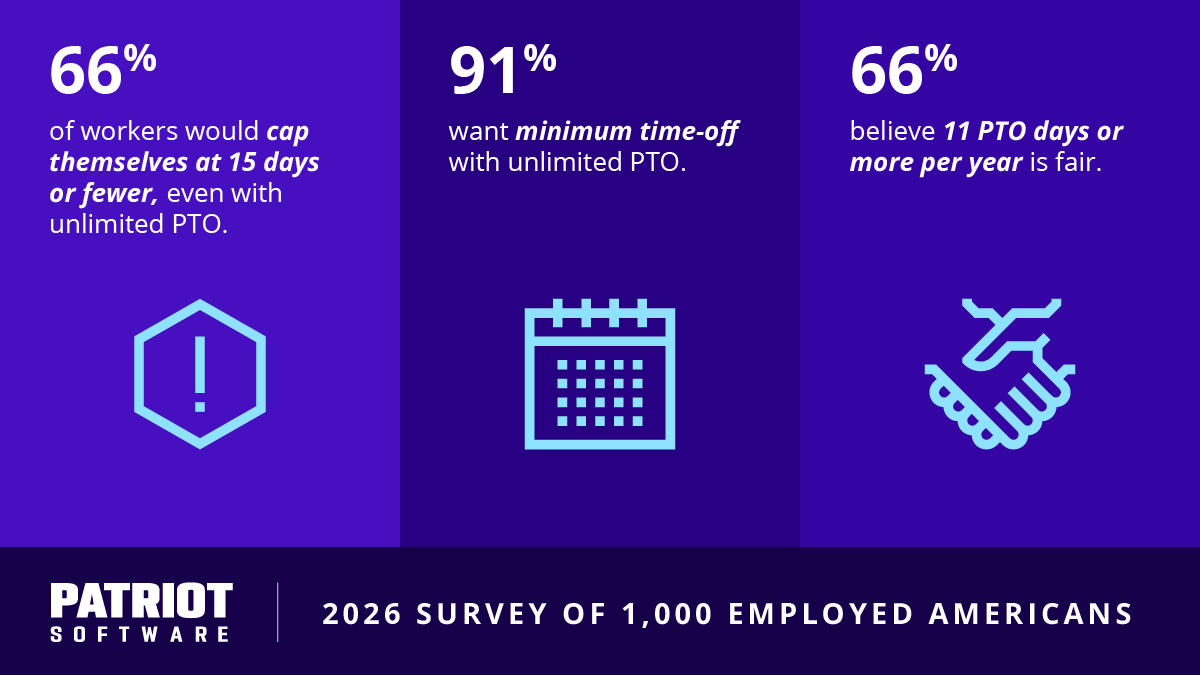
Patriot Software survey of 1,000 U.S. workers finds widespread confusion, generational divides, and financial strain around paid time off policies.
Continue reading “Two-thirds of Workers Would Self-impose Caps With Unlimited PTO, New Survey Finds “