How to Run Net to Gross Payroll
You can use our Net to Gross Payroll tool if you want an employee to receive a specific amount after taxes. Instead of the traditional method of calculations starting with gross pay, Patriot’s Net to Gross Payroll tool reverses the calculations. Also called “gross-up payroll,” the tool allows you to start with the net pay you want an employee to receive.
When would you use the Net to Gross Payroll tool?
- Running a bonus with a specific take-home amount
- If you want an employee to receive exactly $500 after taxes on a bonus, enter $500 as the net pay. Patriot calculates the gross needed to deliver that amount. This also applies to supplemental wages such as relocation or travel expense reimbursements.
- Recording a cash bonus or gift card already paid outside of payroll
- The IRS considers gift cards a taxable fringe benefit because they are a “cash equivalent.” If you gave an employee a $100 gift card outside of payroll, you must still report and tax it. Enter $100 as the net amount and Patriot calculates the taxes owed.
- Running a special payroll to maximize a retirement deduction with zero take-home pay
- If you want to run a payroll that covers a 401(k) or other retirement deduction with no money going to the employee, enter $0 as the net pay. This is often used by owners or shareholders of a corporation at year-end to maximize their retirement contribution. Note: this only works when you have a specific deduction amount in mind — not a specific gross pay amount.
Limitations of the Net to Gross Payroll Tool
The Net to Gross tool is not available for the following situations:
- Employees who live in one state and work in another (these employees appear in the dropdown but cannot be selected and will show a warning message)
- Money types: Tips Already Paid and Tips Owed
- Deductions with the method “Post-Tax % Disposable Net Pay”
- Deductions of type “Post-Tax” with a method of “Percent”
- SIMPLE IRA contributions and deductions
| 💡 Important! At this time, the Net to Gross payroll tool does not integrate with accounting softwares. Please make a journal entry for when using this tool. |
How to Gross-up Payrolls with the Net to Gross Tool
- Go to Payroll > Payroll Tasks > Net to Gross Payroll
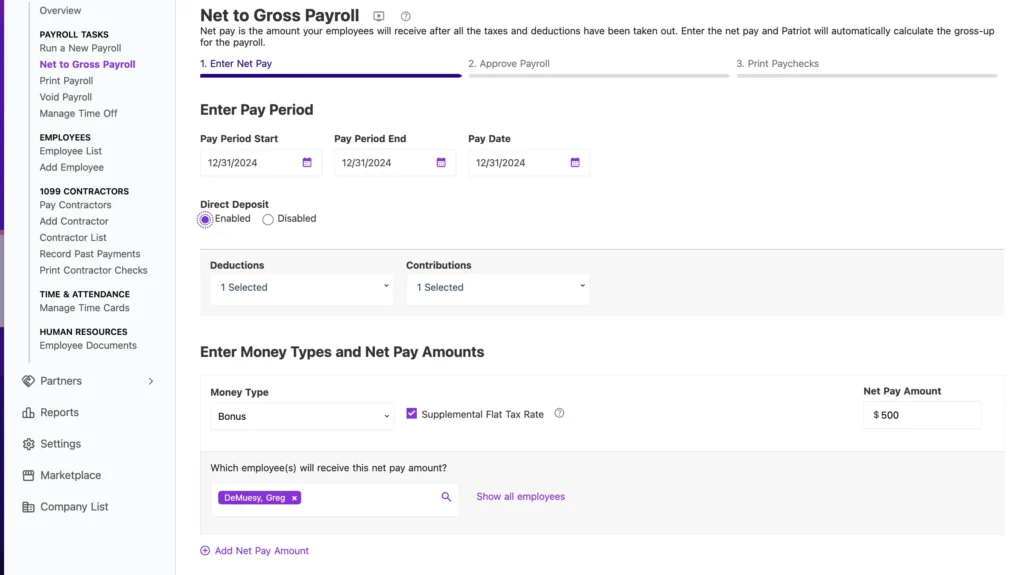
- Enter the Pay period start date, pay period end date, and the pay date.
- Direct deposit will be enabled by default. To pay by check or gift card instead, click the Disabled radio button next to direct deposit.
- Select deductions or contributions to include on this payroll, if applicable. No deductions are selected by default.
- Select a money type — the pay category used to classify what you are paying (for example, Bonus or Commission). Active money types Bonus and Commission are available by default. Any custom money types you have created in Settings also appear here.
- Active money types Bonus and Commission have displayed, and any additional custom money types you have set up in the software.
- Check the box if you want to use the supplemental tax rate. For more information on supplemental pay, please read our article, “What You Need to Know About Supplemental Pay.”
- Check the supplemental tax rate box if this payment should be taxed at the IRS supplemental wage flat rate instead of the employee’s regular withholding rate. For more information, see “What You Need to Know About Supplemental Pay.”
- Select which employee(s) will receive this net pay amount. Search by name or click “show all employees” to see a full list. Check “Select all employees” to select everyone at once.
- Enter the Net Pay Amount — the dollar amount the employee should take home.
- To pay multiple employees different amounts, click +Add Net Pay, then select the money type and employees for each additional amount.
- Each employee can only appear in one net pay group at a time.
- To remove a net pay entry, click the trash can icon next to the money type.
7. Click the “Next Step” button to proceed to Step 2a of the Net to Gross Payroll. A summary of the calculations will be the default view. To view all the payroll details, click the “View Details” link at the top of the page.
8. Approve the net-to-gross payroll to post the payroll for the employee.
You can view the payroll on the payroll register Reports > Payroll Reports > Payroll Register, or on the employee record Payroll > Employee list > {Employee name} > Paychecks.
How to Gross Up a Cash Bonus or Gift Card
Use this process when you have already paid an employee a cash bonus or gift card outside of payroll and need to record the taxes.
Step 1: Create a Money Type for the Bonus or Gift Card
- Go to Settings > Payroll Settings > Hours & Money Types.
- Click Add New in the Money Types section.
- Enter a name (for example, “Gift Card” or “Employee Goodwill”).
- Leave Frequently Used unchecked unless you want this money type to appear on every payroll.
- Leave the W-2 Box field blank.
- Leave Taxable checked.
- Leave W-2 Third Party Sick Pay unchecked.
- Click Save.
Step 2: Run the Net to Gross Payroll
- Go to Payroll > Payroll Tasks > Net to Gross Payroll.
- Click Disabled next to direct deposit (since the payment was already made by gift card or paper check).
- Select the money type you just created (for example, “Employee Goodwill”).
- Enter the gift card or bonus amount in the Net Pay Amount field.
- Select the employee(s) who received the bonus or gift card.
- Click Next Step. Review the summary (or click View Details for the full breakdown).
- Approve the payroll to post it.
View the completed payroll at Reports > Payroll Reports > Payroll Register, or on the employee record at Payroll > Employee List > [Employee Name] > Paychecks.
Special Payroll to Cover Deductions with Zero Net Pay
Use this process when you want to run a payroll that contributes to a retirement fund (such as a 401(k)) but results in no take-home pay for the employee. This is most commonly used by owners or shareholders of a corporation at year-end.
| Note, if you have a Vestwell 401(k) plan, and you are an owner looking to make a large contribution to your own account at the end of the year, you will need to change your deduction in your Vestwell portal, and wait for your deduction to be updated in Patriot’s system before you follow these steps. Contact our Customer Care team if you have questions. |
Step 1: Create a Money Type for This Special Payroll
- Go to Settings > Payroll Settings > Hours & Money Types.
- Click Add New in the Money Types section.
- Enter a name (for example, “Retirement”).
- Leave Frequently Used unchecked.
- Leave the W-2 Box field blank.
- Leave Taxable checked.
- Leave W-2 Third Party Sick Pay unchecked.
- Click Save.
Step 2: Confirm the Employee Has a Retirement Deduction Set to a Flat Amount
The employee must have a retirement deduction already assigned with a specific flat dollar amount. If you have not set this up yet, see “Company Level Deductions” and “Employee Level Deductions” in the help center.
To adjust an existing retirement deduction amount:
- Go to Payroll > Employee List > [Employee Name] > Deductions.
- Click Edit on the retirement deduction.
- Enter the flat dollar amount you want to contribute, keeping annual IRS contribution limits in mind.
- Click Save.
Step 3: Run the Net to Gross Payroll
- Go to Payroll > Payroll Tasks > Net to Gross Payroll.
- Enter the pay period start date, pay period end date, and pay date.
- Select the retirement deduction to include on this payroll.
- Select the money type you created in Step 1 (for example, “Retirement”).
- Select the employee(s) for this payroll.
- Enter $0 as the Net Pay Amount.
- Click Next Step. Review the summary (or click View Details for the full breakdown).
- Approve the payroll to post it.
View the completed payroll at Reports > Payroll Reports > Payroll Register, or on the employee record at Payroll > Employee List > [Employee Name] > Paychecks.
Your feedback will not receive a reply. If you have a specific issue, please reach out to our support team here.